
The Hidden Dangers of Intermittent Fasting (Women Over 40 Need This) - 268
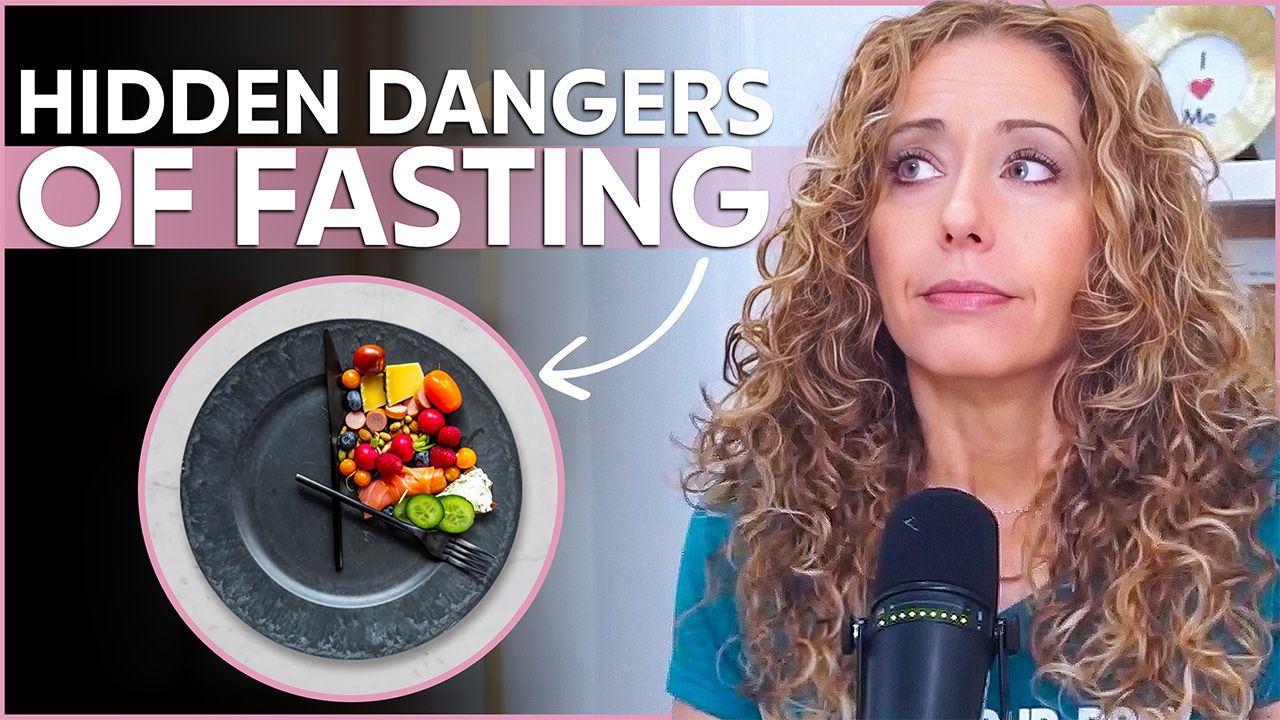
You’ve probably heard about the incredible benefits of fasting: weight loss, better metabolism, and even cellular repair. But for many women, it leads to fatigue, food obsession, and stalled weight loss.
In today’s episode, I’m unpacking why intermittent fasting isn’t working for you, especially if you’re a woman navigating hormonal changes. I’ll explain how intermittent fasting affects women in perimenopause and menopause differently than it does men or younger women.
Plus, I’ll share research that shows how fasting could actually disrupt your health and metabolism instead of improving them. If you’ve been frustrated by a lack of results from fasting, I’ll walk you through what you can do to fuel your body without the extremes of dieting.

Conclusion:
Don’t let the noise about intermittent fasting keep you stuck in a cycle of deprivation and frustration. Focus on nourishing your body with balanced meals, movement, and a mindset that prioritizes health over weight loss. Your body deserves consistency and love, not restriction.
In This Episode:
00:00 Introduction to intermittent fasting
06:19 What “working” in diet culture really means
10:04 Promises vs the reality of intermittent fasting
12:17 Research gaps in fasting for women
16:41 How fasting can mask or worsen underlying health issues
20:56 When fasting leads to cortisol and stress without autophagy
26:31 Three questions to ask before fasting
28:07 Why intermittent fasting is problematic for women
34:31 How to fuel your body correctly
Join the waiting list for Carrie’s upcoming book, From Corset to Crown!
Sign up here: https://www.carrielupoli.com/corsettocrown
Listen to This Episode on Your Favorite Podcast Channel:
Follow and listen on Apple
Follow and listen on Spotify
Subscribe and watch on YouTube
Connect with Carrie Lupoli:
Other Related Episodes:
Looking for more tips to optimize your health? Listen to these episodes:
- This Might Be Why You’re Not Losing Weight
- My Labs Say I’m 38, But I’m 51 – 3 Habits That Reversed My Biological Age
Transcript:
[00:00:00] Carrie Lupoli: So if intermittent fasting is supposed to be this metabolic miracle, why are so many women feeling more exhausted, more obsessed with food, and more stuck with their weight than ever before? Even if they're fasting? Well, because almost every woman I talk to that's tried fasting, that's tried skipping breakfast, doing that 16 eight window thing, or pushing their first meal later and later because they heard it would help burn fat.
[00:00:25] Carrie Lupoli: They're saying the same thing over and over again. Everyone says it's amazing, but it doesn't work. For me. So today we're gonna unpack something that honestly shocks me in the hundreds of podcast episodes I've done. I've never done one just completely dedicated to intermittent fasting, which is crazy because I talk about it all the time.
[00:00:43] Carrie Lupoli: And the truth is this, the reason intermittent fasting isn't working for you is because it doesn't work. You're not doing it wrong. It was not designed for your body in the first place. Especially if you are a woman in perimenopause, menopause, or post menopause. So [00:01:00] today we are going to unpack why intermittent fasting promises, what it does, what the research actually says, where the gap is and why it doesn't apply to women like us, and what's really happening in your body when you skip meals.
[00:01:15] Carrie Lupoli: Because once you understand this. The confusion is gonna completely disappear.
[00:01:22] Carrie Lupoli: So this is a podcast I've never done before in the hundreds of podcasts that I've done. I can't believe I haven't done one single episode focused completely on. Intermittent fasting, and I don't know why. I, I, I, I talk about all the time in my life and almost every woman I talk to has tried intermittent fasting at some point, and they're so confused because they tell me all the things that they've heard about why it's so good and yet.
[00:01:55] Carrie Lupoli: Everybody that comes through my path will say to me, but it doesn't [00:02:00] work for me. And so we need to unpack. I need to, I need to dedicate an entire episode to unpacking this confusion around intermittent fasting and why the research. And I'm going to use that word very loosely, quote unquote. Research tells us how incredible this is, and yet for you, a woman in perimenopause, menopause, or postmenopause.
[00:02:27] Carrie Lupoli: It's not quote unquote working. We're gonna unpack all of that today. We're actually gonna tap into research. I'm gonna tell you what the research actually says and why some of it doesn't translate over to you, because I'll be the first to tell you that I know what people are talking about when they talk about the benefits of fasting.
[00:02:50] Carrie Lupoli: And I also know why it's not working for you. We have a lot to unpack in this episode, and I'm excited about it. I really can't believe I've never done [00:03:00] one on this before, so it is time. All right, so let's talk about what. As touted as intermittent fasting, maybe you are told not to eat until noon. Maybe you've tried that 16 eight window where you're fasting for 16 hours and eating in an eight hour window, or I actually just ran into somebody that did.
[00:03:23] Carrie Lupoli: A 48 hour fast. Uh, and it it, like, the reason I laugh is not because I think it's funny, it's just because it just sounds so miserable. There's nothing I hate more than feeling really hungry. When I feel really hungry, that's when I want. All the things, the chips, the bread, the candy, the sugar, all of that.
[00:03:49] Carrie Lupoli: And I know when I was dieting and I was counting calories and I was in that whole world of deprivation, I always felt like it was a badge of honor to push through hunger. [00:04:00] And then an intermittent fasting comes along. It's supposed to be this metabolic miracle and they have to like push past the hunger.
[00:04:10] Carrie Lupoli: It's just affirming all of the things that diet culture tells us we need to do. It really depends when women tell me they've tried it and it doesn't work, what I have seen is it depends when they've tried it in their lives. But bigger than that, it also is dependent on what your definition of working means.
[00:04:31] Carrie Lupoli: This is a really big piece to unpack first, because if we don't align on what it means when something is working well, then we aren't going to align on the messaging as to whether or not it's effective. We have to first figure that out. What does it mean to you when you say a diet worked? And let's be real clear here.
[00:04:53] Carrie Lupoli: Intermittent fasting is dieting. I don't care if you are [00:05:00] a health coach, a nutritionist, a dietician, a doctor who says they don't believe in the diet, culture, dogma. But you tell your women, patients, clients, whomever, that fasting is really important. You are absolutely buying into diet culture dogma. You either are a part of the cultural conditioning around the diet industry or you're not.
[00:05:31] Carrie Lupoli: And when you tout intermittent fasting. Especially for reasons of weight loss to women. Understand the underlying message you are sending is diet, culture, diet, culture toxicity. It is so interesting to me because everybody will say diet culture is toxic, but I see influencer after influencer and these quote unquote health coaches and uh, experts, if you will, talking about.[00:06:00]
[00:06:01] Carrie Lupoli: I cannot wait to unpack this because I am hoping that not only you as a. Consumer, as a woman, as a human will get something out of this for their own lives. I hope that if you are a professional, you're thinking differently about this as well. Okay, so what is the definition of something working in the weight loss diet industries?
[00:06:22] Carrie Lupoli: We talk about weight loss as being something that works. What we need to do is blow up the word weight loss and working as the same thing. If we truly care about health, because we can lose weight and a whole lot of unhealthy ways, when someone has cancer, they are often losing weight, and they are yet at the unhealthiest they've ever been.
[00:06:53] Carrie Lupoli: But our weight loss diet culture aligns losing weight with [00:07:00] the goal. The goal has to change. The goal has to be about true deep health. What we do in terms of putting food in our body, or not putting food in our body, what we do to get healthy when it comes to food and exercise is literally getting us to what Courtney Town lead, the author of the Consistency Code, an amazing book, by the way, called Basecamp, that is literally getting us to Basecamp when it comes to truly being healthy, healthy.
[00:07:30] Carrie Lupoli: Is around so many different aspects of who we are, what we do, what we believe, what we think, how we act, how we respond. Finance, finances, parenting, relationships, healthy from the inside out is multilayered and a journey that never ends. Which is why I think in so many ways it's hard to come up with a meal plan, a system, a diet that will actually get us healthy because no diet will get us [00:08:00] healthy if we really align the concept of health being multilayered.
[00:08:03] Carrie Lupoli: So the diet dogma world. That puts us in a cage and then blames us when we don't fly. Tells us that your goal is to be smaller. Your goal is to lose weight. Oh, you know that corset that we put on you when you're about eight, nine years old, the one that you didn't choose to put on, but the culture put on you, the one that you have been taught has to get tighter and tighter.
[00:08:24] Carrie Lupoli: You have to shrink and drink. You have to be smaller in order to be valuable. That one. Oh yeah. So there's, here's how you do it. You just don't eat. You just literally stop eating for big portions of the day. Oh, okay. Well, is that gonna work? Sure. You don't eat, you can lose weight. Well, it also depends on how old you are, but do you want nutrients in your body or do you want just to deprive your body?
[00:08:57] Carrie Lupoli: Because let's be honest, I always say that fasting is just a [00:09:00] bougie way of restricting calories. That's what it is, and what I hear from women who are fasting is, one, it is miserable. Two, they have stronger cravings. Later in the day. Three, they have stalled weight loss, which is always the kind of selling point of intermittent fasting.
[00:09:14] Carrie Lupoli: Three, they have total fatigue. Their workouts aren't as strong, their sleep is disrupted, but they're doing everything right when it comes to fasting. And when we look at the research, we know why we are confused. So let's dig into that because we've established the fact that working cannot just be about weight loss.
[00:09:38] Carrie Lupoli: So that actually can throw out the whole argument event in intermittent fasting because it just miserable. And if you're gonna be miserable, you are not healthy. You are just not. But let's move past that a little bit and let's just talk about the weight loss factor. Especially for women in menopause and truly what we need and [00:10:00] want if we truly want a sustainable approach.
[00:10:04] Carrie Lupoli: Okay, so intermittent fasting promise is a whole bunch of stuff, right? I I, I see this all the time. My feed is all, it drives me crazy because I, I often see fasting when it comes to blood sugar regulation and everybody knows that I teeth blood sugar regulation, but I teach it through actually eating.
[00:10:24] Carrie Lupoli: What people talk about is intermittent fasting promises lower insulin. It also promises that you'll burn stored fat, improve your metabolism. It will simplify your whole life 'cause you just don't eat, you don't have to worry about. And then it promotes autophagy, which is cellular repair. Kind of like killing off those weak cells and replacing it with stronger, healthier cells.
[00:10:47] Carrie Lupoli: So it, I feel like there's two camps on the intermittent fasting side. If a woman is fully engrossed in losing weight, she will think about intermittent fasting in terms of eat less, move more people that are [00:11:00] like those biohackers health like kind of nuts. Think about it in turn of, in terms of autophagy.
[00:11:07] Carrie Lupoli: Which is that cellular repair. And so whenever somebody asks me about it, especially if I'm any big podcast with biohacking and they'll bring up fasting in terms of cellular repair, and I have to have this whole like conversation about this, and we're gonna get into that today, but it's the idea that if we deprive the body of food long enough.
[00:11:26] Carrie Lupoli: Long enough then our insulin drops because we have this knowledge. And I will say that it is true for many people that every time we eat, we spike our blood sugar. So if we could just not eat, we could put our blood sugar into regulation. I get the theory. The problem is that what we are doing while we're eating is spiking our blood sugar like crazy.
[00:11:45] Carrie Lupoli: And so if you just say, let's just not eat, we can keep our blood sugar under, under, um, control. I guess it makes sense on paper, but what if we could actually eat and not spike our blood sugar? That would actually solve the whole [00:12:00] problem of that insulin sensitivity and the blood sugar rollercoaster.
[00:12:04] Carrie Lupoli: Right. And it's this theory that if we deprive the body long enough that the insulin will drop and then the body will switch from burning glucose into burning stored fat. Okay. That's the idea. There is research. You can find a ton of research on this, and I have article after article about different, like research on fasting, circadian rhythms, time restricted eating.
[00:12:29] Carrie Lupoli: I'm not arguing that you can't find a lot, however. There's a huge research gap, and I say this all the time about every single nutritional research article study out there. When you study people, you are also faced with the variables of their past, of their lifestyle. Of their mindsets, of their stress levels.
[00:12:57] Carrie Lupoli: So many different factors that it [00:13:00] makes studying not even short term, but especially long term, but both of them concepts very, very hard to be reliable. I say this all the time, like there, there's some studies on plant-based eating. And a lot of the people that go to a plant-based diet on these studies were literally eating highly processed fast food.
[00:13:24] Carrie Lupoli: So if you literally just cut out the highly ultra processed food and replace it with anything that's more natural, you're gonna see progress. It doesn't necessarily mean it was the plant-based eating that did it, it meant. Uh, we're just not eating as many ultra processed foods, and that's why there's so many variables in every single nutrition study.
[00:13:43] Carrie Lupoli: So there's a lot of studies also done in rats, and I get it. You don't have the same variables that you do with humans when it comes to rats, but you also don't have exactly the same types of situations when it comes to humans versus rats mainly. Who? Our [00:14:00] lifestyle, because what ha. In order for something to actually work, we have to be able to do it.
[00:14:06] Carrie Lupoli: We have to be able to do it consistently. And, uh, rats, they'll just do whatever we do to them. They don't, we don't deal with their mindsets, their belief systems, the PTSD, the food noise, like all of those pieces of the puzzle. So it's always really hard when it comes to research, right? But. Understand that many fasting studies were actually, especially in the very like initial stuff that people still quote today were conducted in the early 20th century.
[00:14:35] Carrie Lupoli: And the reason why was because when we actually were in the Great Depression, when we had major fiscal downward trends in our world, there were studies on, okay, how, how much can we not feed people and have them still survive? And it just like my example of if you took a bunch of people that were gonna McDonald's all the time and give 'em plant-based diet, you're gonna see progress.
[00:14:58] Carrie Lupoli: A lot of these people that we have [00:15:00] done studies on were people that were metabolically very unhealthy and obese, and anytime you change their diet to something that is less caloric, if they were eating so much food before that was ultra processed and we turn it into just eating less food. Then yes, people will likely lose weight.
[00:15:24] Carrie Lupoli: Does that mean that is the most effective approach? Most of our studies are done on male subjects. There's actually a study that came out in 2025, which is really interesting because it's so recent and this came out in the Journal of Midlife and it just came out in the early, the first quarter of 20 20, 25.
[00:15:44] Carrie Lupoli: So just. A year ago, it says, the studies on the effect of intermittent fasting among menopausal women are scarce, unsupervised, intermittent fasting may result in nutritional deficiencies. Also, fasting episodes can have effect [00:16:00] on reproductive hormones, estrogen, progesterone, and testosterone, which affect physical and psychological wellbeing in women.
[00:16:07] Carrie Lupoli: This is what we need to understand. Many of our studies involve men. It involves sedentary or very metabolically unhealthy individuals. We can go on and on. There's an annual review of nutrition in 2017 that was done on the metabolic effects of, of intermittent fasting, and that was exactly the case. Men and very, very obese and metabolically unhealthy people.
[00:16:31] Carrie Lupoli: So how does that translate to women in menopause? It doesn't. Active women are rarely the primary focus. So when you are intermittent fasting, what is actually happening in your body? There are a bunch of things going on that we don't realize is happening that's actually derailing the progress that we want, and I get it like I want you to want to truly [00:17:00] understand optimal health, but if you are.
[00:17:02] Carrie Lupoli: Overweight. If you are obese, I understand weight loss is part of the equation, but weight gain and stubborn weight loss is a symptom of hormonal balance and health. So if we can actually. Overcome those things. Weight loss becomes a byproduct, but if we are doing things that are going to cause hormonal disruption and not actually get us towards health, then while it may tout weight loss, it will never work.
[00:17:34] Carrie Lupoli: Which is why you have tried intermittent fasting before and it's that working for you, quote unquote, because your definition of working is about weight loss, but it's actually impacting your health. Therefore, an unhealthy body will not release weight. If you are struggling releasing weight and we know that you are depriving yourself of food, you are not metabolically healthy.
[00:17:58] Carrie Lupoli: So one of the very first [00:18:00] impacts of intermittent fasting is actual blood sugar instability because what we know is instead of stabilizing insulin, fasting can actually lead to greater glucose variability in in certain people. Again, people who are. Very obese and at the top of what I call the metabolic pyramid of disease because we are overeating.
[00:18:23] Carrie Lupoli: If we just, uh, literally reduce some of that, it's going to look like that's helping. I get that, but when I teach blood sugar stability, I'm teaching about eating small meals with whole clean, unprocessed food as much as we can over the course of the day that we are awake. It is amazing how satisfying it is and how effective it is because again.
[00:18:47] Carrie Lupoli: Pushing through hunger is miserable and it actually increases your cravings. It is very, very hard while you're fasting for somebody that is obese or metabolically dysregulated, yes, it can look [00:19:00] like your insulin is regulated, but the minute you eat because you're so insulin sensitive and because your blood sugar is low or you're very hungry, you will likely eat more than what you probably should be at that time.
[00:19:15] Carrie Lupoli: And your blood sugar is going to spike every time you eat. So the argument is, well, if you're eating less in a smaller window, your blood sugar's only spiking during this window and it's not spiking during this other window. How about we actually adopt a practice, though that means we are not spiking at all and we're still eating and we're still satisfied because every time you spike your glucose.
[00:19:39] Carrie Lupoli: Due to food, your body has to continue to over release insulin. If you're already obese and metabolically unstable, your insulin is getting less and less effective at actually bringing down those glucose spikes. So when you are fasting, it just, it, it consolidates the period of time that you're doing. You have these blood sugar spikes when you [00:20:00] are eating, and that is not better for you.
[00:20:03] Carrie Lupoli: That's just as bad. Okay, so I mean, I like we could literally go through study after study that tells you why it works, and yet I can show you over and over again in. Not just studies, but also in my experience of how when you actually are eating in small portions, your three macronutrients, protein, fats, and less dense carbohydrates, you can keep your blood sugar stabilized all day long while giving your body nutrients 'cause we are a refuel as you go machine.
[00:20:40] Carrie Lupoli: It's like driving a car on fumes and then trying to overfill it when you get to the gas station, it doesn't work like that. And so we know the power of blood sugar regulation, which is the argument, very much of intermittent fasting, but it doesn't translate at all. In addition, we talk about how skipping meals [00:21:00] becomes a physiological stressor.
[00:21:02] Carrie Lupoli: The cortisol and stress response of skipping meals is also in some ways, the argument for intermittent fasting, that it causes autophagy and that stress on your cells actually kills off the weaker cells and and allows the stronger cells to come in in its place. But the studies on autophagy is like, you have to significantly be in such a controlled deficit for autophagy to work.
[00:21:29] Carrie Lupoli: And it, to me, I, I literally just met somebody that had been fasting for 48 hours and he started eating a little bit after the 48 hours. He couldn't function, he couldn't think, like we had a conversation and he was struggling to talk. That to me is. Is just, it's not acceptable as humans. And I know that it's not necessary, especially for autophagy.
[00:21:56] Carrie Lupoli: You can go into a sauna or a coal plunge if that's what you wanna do. [00:22:00] Like I sauna every single day in longevity studies that there's a 21-year-old, 21 year study on the impact of. Sauna and for people that were sauna in for four days a week, there's a 65% reduced chance of Alzheimer's. Alzheimer's is being known as type three diabetes, and we know that autophagy, blood sugar balance, detoxification can all happen with sauna, which sauna ink.
[00:22:29] Carrie Lupoli: I love to saada, like imagine doing something that is so, feels good, and is so good for you and there you go. You don't have to have that argument anymore when it comes to fasting, especially because like I am not going to allow myself to just not be able to function after a fasting session. And I know when I am hungry, I crave so much more.
[00:22:52] Carrie Lupoli: And I love the idea of the discipline of declining, the discipline of saying no to yourself, but not at that expense. I wanna like learn how to say [00:23:00] no to the second cup of coffee or how to say no to a glass of wine when I know it's not serving me. Like that's the kind of discipline of declining that I think we should practice.
[00:23:10] Carrie Lupoli: Not completely taking away nutrients for days at a time. Like we need fat to actually keep our brain going. And that was one of the reasons why he couldn't talk. So when we are fasting, we have all this higher cortisol. Cortisol is a hormone well one. When one hormone is off, all hormones are off. And for women in a hormonal crazy time.
[00:23:32] Carrie Lupoli: Adding more dysregulation to our system is not okay. It will increase your abdominal fat storage. It will totally disrupt your sleep, and it will increase your appetite. Those are all the impacts of increased cortisol and then add cortisol from just life. And just the stress of life. And so then when your energy actually drops, because you're not fueling yourself, 'cause you're not giving yourself nutrients, your body will [00:24:00] then adapt by reducing its metabolic rate.
[00:24:03] Carrie Lupoli: And there is a really, uh, powerful study in 2016 in the obesity journal about the long-term metabolic slowdown after weight loss from fasting. And it's really scary. Like you've seen the Biggest Loser, right? And how they all regressed. This is why they've called obesity a disease because people could lose weight and then they gain it back.
[00:24:25] Carrie Lupoli: And because it's, um, it's repetitive, it's diagnosed as a disease. But what if we're actually just not giving people the right strategies to be able to do this sustainably? Because when you force somebody to actually deprive themselves, your body and your mind doesn't wanna keep going there. Your brain and your body are going to conserve energy and then when you do feed it, it's gonna hold onto it because it wants to be fed and it doesn't know exactly when it's going to happen.
[00:24:54] Carrie Lupoli: We also have massive exercise recovery issues when we're fasting because I see in our, like I [00:25:00] see this all the time, fasting and combining it with exercise like cardio or intense workout. But when your fuel availability is low, research shows that that low energy availability will absolutely negatively impact your hormone function and performance.
[00:25:15] Carrie Lupoli: There was actually a study done in 2018 that combined all sorts of research. Uh, the International Olympic Committee did this actually on low energy availability and how it impacts thyroid function, reproductive hormones, bone health, immune function. It's. Craziness. And if you are an active person, especially, we're not fasting.
[00:25:39] Carrie Lupoli: Sta Dr. Stacy Sims, who is one of the leading women's health, um, kind of influencers, health pros out there, says all the time, like, stop it. We're gonna do another episode on ke. Keto fasting. No, it's, it's disrupting us and it's not necessary and it's so miserable. And, and then just to, not [00:26:00] overstate, but the, the argument, the group that are all about weight loss, like.
[00:26:05] Carrie Lupoli: I can, uh, we can talk about that all day long, especially because of everything that I just stated. And then you talk about people that are all health driven, like the biohackers and talk about autophagy. But those benefits are actually really kind of overstated because so much of that research about autophagy is coming in animal models that are not actually like going to work every day and needing to cognitively function and extreme fasting conditions.
[00:26:31] Carrie Lupoli: One of the things that I say all the time is, before you introduce any nutritional approach, you need to be able to ask yourself three questions. One, is it based in science designed for my body to thrive? Intermittent fasting is based in science. You've seen the science, which is why you've tried it, but is it designed for your body to thrive?
[00:26:47] Carrie Lupoli: This is all about putting your body at an extreme deficit. Name one thing that thrives in a deficit. You can't. You can't, and our bodies are the same way. We are a refuel as you go machine. So question number one, [00:27:00] is it based in science? Yes. But is it designed for your body to thrive? No. Question. Number two, can you do it for the rest of your life?
[00:27:06] Carrie Lupoli: You can't just fast all the time and your body wants a relationship with you. Like any other relationship and relationships that are effective, that are strong, that are long lasting, are based in trust, trust. It comes from positive interactions consistently over time. Not perfectly, but consistently. And if you are intermittent fasting, you are automatically being inconsistent with your body.
[00:27:30] Carrie Lupoli: It doesn't like that. And question number three is, would you let a kid you love do this? Would you let a kid you love actually fast? Our bodies are physiologically the same. And if your answer is no to kids, and it needs to be no to you, A, you're not modeling appropriate habits and B, this is why it's not working.
[00:27:49] Carrie Lupoli: If you wouldn't let a kid do it, why are you doing it? It doesn't make sense, especially. When we get older and we need to preserve [00:28:00] muscle mass, our bone density, our energy levels, our hormonal balance. So let's just kind of now dig into what I think is the most important piece of this puzzle. Intermittent fasting for most women.
[00:28:19] Carrie Lupoli: And there is so much research on this on every single one of these diets, but intermittent fasting, especially around anybody with disordered eating is extremely problematic. And 85 to 90% of women have disordered eating. The average woman has started and stopped six diets a year. We know it's the whole reason I wrote from corset to crown.
[00:28:46] Carrie Lupoli: I am here to disrupt everything that we've been told about weight loss, confidence, self-worth. We have been made to believe that the corset that's on us has to continue to be tightened more and more and more. And intermittent fasting is so interesting [00:29:00] 'cause it's so miserable and it requires so much willpower and discipline to literally not eat.
[00:29:06] Carrie Lupoli: That it is forcing us to pull on those laces of that corset more and more and more. And when women come to me, they're finally like, I can't breathe anymore. But what we do is we take off the corset and then we're like, screw it. Forget it. I am done. I don't even care anymore. And that's not the attitude.
[00:29:23] Carrie Lupoli: The attitude has to be that we love ourselves too much to do things that are deeply unhealthy. We are have been going after weight loss and not health for so long, and we don't even see that being miserable, depriving ourselves. Just having this scarcity mindset about food and our bodies is just in and of itself unhealthy.
[00:29:46] Carrie Lupoli: And so if men wanna go after intermittent fasting because they believe they're good doing the autophagy thing and all of that, go for it. I still will argue because I've worked with so many men that it's not [00:30:00] necessary. But for women don't believe the lies. It's perseverating the problem as we get older, especially around hormonal balance.
[00:30:10] Carrie Lupoli: But even more importantly, it's perseverating your disordered thinking that you need to continue to tighten that corset and eventually you'll be like, I can't do this anymore. Screw it. But instead of actually taking off the corset and putting on a crown, knowing your value and recognizing that it is not about a number on a scale, you will then go the other direction because you'll be like, screw it, I don't care.
[00:30:36] Carrie Lupoli: And then you will become deeply unhealthy by going in the other direction of binging, of not focusing, not being intentional, and not showing up for yourself. I want women to be at an optimal weight. That's one of the many symptoms that tells us we are becoming the healthiest version of ourselves. But I will argue all day long that intermittent [00:31:00] fasting is perseverating diet culture, the cultural conditioning to tighten the corset and for us to actually become malnourished.
[00:31:09] Carrie Lupoli: It's not working, and it's something that if we wouldn't let our kids do, we cannot continue to do. So many women are obsessed with food and anxiety around food in their bodies, and then you add intermittent fasting on top of it, and you can't go out to breakfast with your girlfriends because you're fasting, or your body doesn't even tell you it's hungry anymore, and you think, oh, it's working.
[00:31:34] Carrie Lupoli: No, your body just has stopped talking to you. It's actually hurting your relationship because your body's like, she's not even gonna listen to us anyway, so we're gonna stop sending those signals. It's like when your high schooler doesn't wanna clean the room and you yell over and over and over again, but you have people coming over and you're like, forget it.
[00:31:50] Carrie Lupoli: I'll just do it myself. Your body's like, forget it. I've yelled at her so many times and I am just gonna go. Take care of it myself. So your body's gonna go grab for the most nutrient [00:32:00] dense part of your body, which is your muscles. You start to lose weight, but really you're losing muscle mass. Then when you gain it back, because you've been on these binge restrict cycles, you actually gain back fat.
[00:32:11] Carrie Lupoli: I say it's like losing gold and gaining back sand. Yeah, but when you can actually eat in a way that's fueling your body all day long, the cravings go away. You can eat with your family all the time. You're satisfied. Your anxiety actually gets, like I, I was going to a doctor for depression and I didn't have to after I started fueling my body.
[00:32:36] Carrie Lupoli: I, I think of Anne, one of my clients who was on anti-anxiety medication for 25 years and six weeks after finally fueling her body and not spiking her blood sugar while doing so. She went off of her medication and hasn't been on since. And it's been years. So if there is a way that you can actually do this without tracking, depriving yourself, feeling like you have to [00:33:00] battle through hunger, doing things you wouldn't let your kids do, having it actually perseverate your disordered thinking about food in your body, focusing on weight versus health, well, why would you continue to do it?
[00:33:14] Carrie Lupoli: So we are going to. Take off the corset. The corset of intermittent fasting, because while it may feel like it, quote unquote works, if you redefine what your definition of working is, is it based in science designed for your body to thrive? Can you do it for the rest of your life? Would you let a kid do it?
[00:33:34] Carrie Lupoli: And is it really focused on true deep health in every single way, psychologically, physically, your lifestyle balance? If the answer is no, then it is time to absolutely ditch that concept. It is just literally another diet wrapped in a fancy bougie term called intermittent fasting, and we gotta be [00:34:00] done.
[00:34:01] Carrie Lupoli: It wasn't designed for us as women. It wasn't designed for a busy life, a stressed out life. It wasn't designed for women who are hormonally dynamic. It wasn't designed, which is all of us. It wasn't designed for women who are strength training, which should be all of us. Our bodies are way too sensitive to those stressors and require food to fuel us and nourish us.
[00:34:26] Carrie Lupoli: Our bodies don't thrive on restriction. They thrive on stability. And so having balanced meals throughout the day with each one of them being a protein, a fat, and a lighter carbohydrate, where sometimes it could be a denture one, but we're focusing on whole clean, unprocessed food as much as possible.
[00:34:44] Carrie Lupoli: Instead of looking at food as good or bad or healthy or un unhealthy, I look at food as it serves my body and it serves my soul. I just have to serve my body more than I serve my soul. I need to be consistent. I need to have protein with every meal, have resistance training. It's actually really simple.
[00:34:59] Carrie Lupoli: [00:35:00] So I'm hoping that today's episode got you thinking differently about what you want, why you want it, and why research will tell you one thing, but it doesn't mean it's what your body needs, especially as a menopausal woman. I would love for you to subscribe to my podcast. I, I purposely wore this shirt because if you're on my YouTube channel, you get the video and it says, love your body.
[00:35:24] Carrie Lupoli: Live your purpose. That's what I want for women. Not to enter into a new diet like fasting because you're so frustrated with your body that you just feel like you have to punish it in order to get what you say you want, what you really want that, what you're really looking for in those diets is peace, love for yourself, but you're never gonna find it when it's forcing restriction, deprivation, and punishment.
[00:35:49] Carrie Lupoli: You have a unique purpose to fulfill in this world. And unless you love yourself the way you love your children and your spouse and your friends, you're [00:36:00] never going to actually be able to achieve that level of a relationship based in love, based in peace, based in harmony and balance. An intermittent fasting is literally just another wolf in sheep's clothing.
[00:36:13] Carrie Lupoli: It's not going to give you what you think you want. Getting yourself to the place of balance is what's so important. So continue to, I'd love for you to comment on, on this podcast. Uh, go over to my website, kerry oli.com and see all the different ways that I try to teach these concepts, whether it's through my podcast or you can go on Instagram every single day.
[00:36:37] Carrie Lupoli: Where I go into, I, I go live on morning time, actually every single weekday at 8:00 AM Eastern time. And teaching these concepts in little bits and pieces over time. I want your lifestyle to be part of your identity, not part of this alter ego of someone that just hates herself into submission [00:37:00] and it intermittent fasting, just perseverates all of that.
[00:37:03] Carrie Lupoli: It keeps us in that cage. It keeps the corset on, and you are born with value. It's time to put on the crown. Remind yourself of that. Speaking of. Corset and Crown. You can go to carrielupoli.com/corsettocrown and go check out my book. Um, I have lots of different resources and, uh, we have a newsletter every single Sunday to get your week started off just strong with 1%, uh, suggestions on how to truly live.
[00:37:33] Carrie Lupoli: Your purpose and becoming the healthiest version of yourself from the inside and the out. All right, this is just the first series, first episode and series of me just unleashing on each diet one by one. Next one, we're gonna talk about keto. Let's go.