
The Truth About Calorie Counting And Why It Doesn’t Work for Women - 270
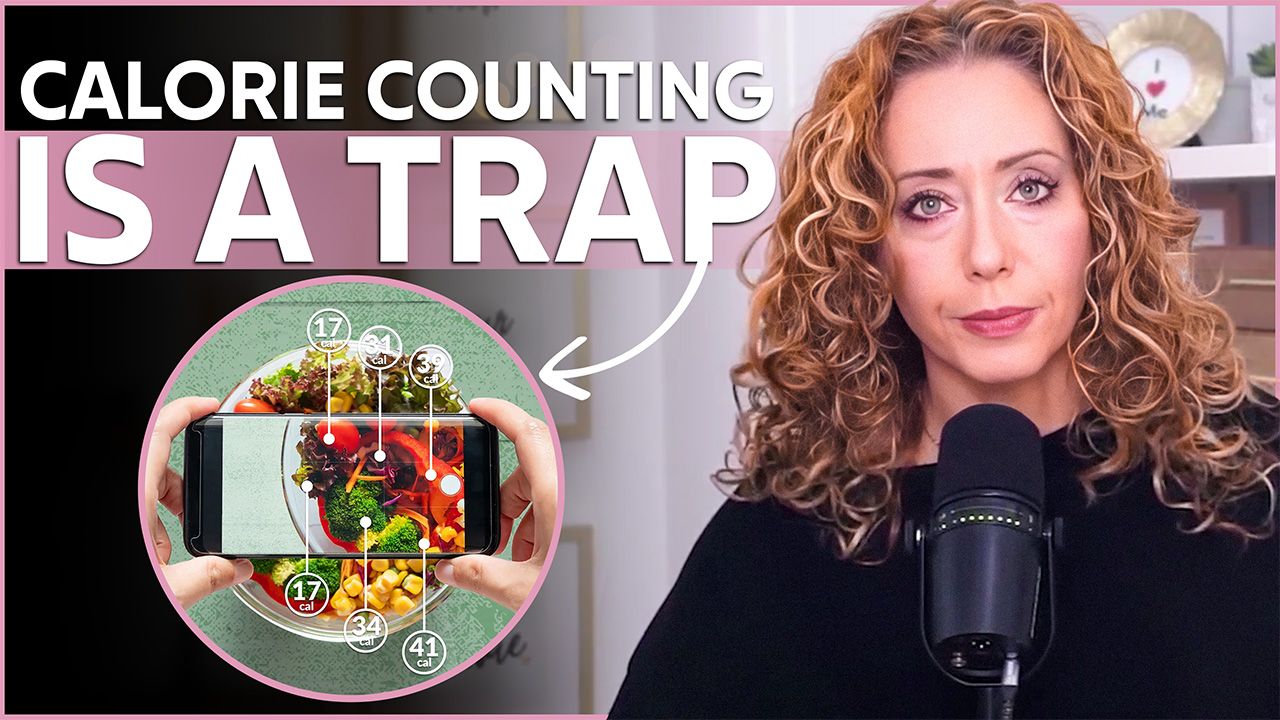
Are you tired of dieting and calorie-counting yet? In this episode, I challenge the calories in, calories out dogma that’s been ingrained in our minds. In its place, I offer a healthier, more empowering approach to wellness.
We will talk about the effects of the calorie-counting mindset and how it leads us to obsess over numbers instead of focusing on our body’s true needs. I share my personal struggles with dieting, how it shaped my beliefs about food, and the real reason many of us are trapped in the cycle of deprivation.
You’ll also hear about Sue, a client who almost let dieting control her life, and how we shifted her perspective to embrace nourishment over restriction. Health is not about eating less, but eating better, and we can break free from the mindset that keeps us stuck in a dieting cycle.

Conclusion:
Dieting doesn’t have to be our concept of health. By changing the way we think about food, we can shift from deprivation to nourishment, and from restriction to freedom. It's time to break free from calorie obsession and follow your body’s natural rhythm!
In This Episode:
00:00 Introduction
01:50 The story of Sue with multiple conditions
06:29 Calorie-counting culture exposed
09:12 How kids learn about dieting and calories
13:43 The problem with calorie counting and deprivation
17:01 Prioritizing food quality over math
20:25 PFC3 alternative to calorie counting
22:09 Why calorie-counting plans fail
27:26 Teaching kids nutrition with PFC Pals
Mentioned in the Episode
Join Carrie every morning live on Instagram: https://www.instagram.com/carrie_lupoli/
Learn more about PFC Pals: https://pfcpals.com/
Join the waiting list for Carrie’s upcoming book, From Corset to Crown!
Sign up here: https://www.carrielupoli.com/corsettocrown
Listen to This Episode on Your Favorite Podcast Channel:
Follow and listen on Apple
Follow and listen on Spotify
Subscribe and watch on YouTube
Connect with Carrie Lupoli:
Other Related Episodes:
Looking for more tips to optimize your health? Listen to these episodes:
- The Dark Side of Keto: What’s Really Happening to Your Body?
- The Hidden Dangers of Intermittent Fasting (Women Over 40 Need This)
Transcript:
[00:00:00] Carrie Lupoli: Everybody wants to know what works. Does keto work, calorie counting work? Does Weight Watchers work? Does Noom work? Jenny Craig, before we keep asking whether it works, maybe we need to ask a better question. What's your definition of something working? Because if it helps you lose weight and then makes you afraid to go to happy hour, terrified of birthday cake, obsessed with tracking and then disconnected from your own body, is that health or is that just.
[00:00:25] Carrie Lupoli: A socially acceptable form of punishment. We've been taught to confuse deprivation with discipline, restriction with wellness and weight loss with worth, but anything that requires you to obsess, to track, to cut out major parts of life, to be perfect to succeed, it was never designed to free you. It was designed to keep you trapped.
[00:00:44] Carrie Lupoli: So today. I'm not just talking about calorie counting, I'm talking about the mindset underneath it, the deprivation, the control, the cultural conditioning, and the lie that smaller automatically means healthier and that you just have to eat less and move more. Because I am not here to teach you how to get better [00:01:00] at dieting.
[00:01:00] Carrie Lupoli: I am here to help you debunk the dogma.
[00:01:07] Carrie Lupoli: Oh, the myth of calories. Calories in versus calories out. Like this is the conversation that I have with people so many times around the power of calories. And so I am real excited to dive into today's episode because it's not just about me wanting to share this information with you. It goes. Deep into my core around the P-T-S-D-I have with calorie counting, and so I can't wait to get into this episode.
[00:01:39] Carrie Lupoli: This is part of a series where I'm debunking all the diet dogma out there because. I, it hit me recently. I, I've never done a series of podcasts on this before, but I had a client named Sue. And Sue, uh, is just such an amazing woman, 64 years old, and came to us kind of kicking and screaming. [00:02:00] It's so interesting because her daughter called me and said, are you taking any more clients in your private practice?
[00:02:04] Carrie Lupoli: And I said, well, you know why? Because we don't, we are not always taking clients. And uh, she said, it's my mom. And now she was a client of mine and still is. All of my clients are still clients of mine. But she learned how to, you know, live the lifestyle that I teach. Right. Really, truly, um, being. Focused on blood sugar, her belief systems, behavioral science, all of that stuff.
[00:02:30] Carrie Lupoli: Okay? So it changed her life and she was a trainer actually, and didn't know this stuff. She had been trying to teach her mother, her mother who was an uncontrolled diabetic, her mother who was on two different insulins, Metformin, had acid reflux, sleep apnea, um, and insomnia. Uh, high blood pressure, high cholesterol.
[00:02:48] Carrie Lupoli: You literally name it. She had it and she was like, my mother is dying and I need you to help her. So I'm like, let's get her on a call. This woman had a very big why, like [00:03:00] if you really think about it staying alive for your family and for your grandkids and all of that, and she was on the brink, like the medication was going to stop working sooner than later.
[00:03:09] Carrie Lupoli: And I, and I know that this happens because we can manage it for so long with medication until the medication barely works anymore. Breaks us from the inside. And so she got on a call and you would think, she'd be like, yeah, all right, let's do this. She didn't wanna do it. She did not wanna work with us.
[00:03:25] Carrie Lupoli: And I never knew why. Her husband finally convinced her that, you know, she didn't wanna spend, she said she didn't wanna spend the money on herself. And her FI husband finally convinced her like, we need to do this, this, this is, this is the priority in our family is you. I don't think, I think she always took care of others and didn't really feel like she should be taken care of.
[00:03:47] Carrie Lupoli: But at the core, she just told me, and this is a year later, she said, do you wanna know the real reason? I didn't wanna do this? She said, because I have done all the diets. And they're miserable, and I didn't wanna do it anymore. I [00:04:00] would've rather just lived my life slowly declining and just enjoying food with my family, being able to go out anytime I wanted to, not think about it, used a medication, and then let just see what happens.
[00:04:12] Carrie Lupoli: And I thought, wow, it hit me because we believe that it's literally. You have to wear the corset. I mean, the name of my book is from Corset to Crown. You either wear the corset, which is so tight, and after decades and decades of having to squeeze it and tighten it in order to be smaller or feel like you're doing the thing that your body needs you to do.
[00:04:40] Carrie Lupoli: She was just like the corsets off. I'm done. And that's what we think. We think when the corset comes off, then we're done and we do nothing. And I'd rather just be able to breathe without the corset. Then see what happens. But the reason why my book is from Corset to Crown is that we [00:05:00] actually need to replace the corset with the crown that we were born with, the crown of worthiness that was always ours.
[00:05:06] Carrie Lupoli: The crown of knowing that we are here for a purpose. Sue is here for a purpose, and to think I'm just gonna cut my life short because all I believe is that there is this corset that is keeping me from breathing, and I don't want that anymore. She didn't even know that she had the crown. She, she forgot because the corset literally takes over our life.
[00:05:26] Carrie Lupoli: She believed that the only way for her to get healthy was to be miserable, and she wasn't willing to be miserable in order to get healthy. She was just like, I'm gonna enjoy the time I have left. And we were like, Sue, like that's not the way this has to be. This is why I call myself an untraditional nutritionist because know everybody out there that's working with people and I don't say everybody 'cause I'm gonna get hate.
[00:05:50] Carrie Lupoli: And I like already, like, you know, I get comments all the time about. My philosophy, because I am very untraditional. I go against what almost every certification [00:06:00] out there teaches. It's why I have my own certification now around the BS that really matters. Belief systems, behavioral science, and blood sugar, because they're all based on these dietary restrictions, these diets, the diet dogma.
[00:06:15] Carrie Lupoli: And it's not so much about the science of it, it's about the. Stuff behind it. The psychology of control and the brainwashing that goes along with wearing the corset, every single one of these. So I've already talked about intermittent fasting, I've talked about keto, and today we're gonna talk about calorie counting because at the end of the day, it's the same wolf in different cheap clothing.
[00:06:37] Carrie Lupoli: Now the majority of certifications for nutritionists, and anytime you talk to a doctor, they're just like, eat less, move more. I see very influential social media accounts. I, I can think of one right now, 2.5 million followers, and he literally had a whole post about how. [00:07:00] All we have to do is like literally, if you are not losing weight, you are not at a deficit enough.
[00:07:05] Carrie Lupoli: Try reducing your calories by 500, and I wanted to tear my hair out. 2.5 million followers are listening to him. Tell women one more time, just eat less. Less is always better. Battle through your hunger tracking means you're disciplined. If you don't track your food, you must not want it bad enough. Weight loss equals health.
[00:07:31] Carrie Lupoli: That's the corset. And I am so tired of that being the story that we keep telling women. And this same influencer with 2.5 million followers also puts posts up about women's mindsets and loving themselves. And then the call to action is Wanna lose 40 pounds in the next six months. I'm like. The two don't exist together, and this is what we have to realize.
[00:07:58] Carrie Lupoli: We keep getting sucked [00:08:00] into telling women what they want to hear, lose weight fast, lose weight fast, lose weight fast. And then we try to tell them the other piece of what they want to hear. That you have value. You are, you know, you, you shouldn't be just tied to a scale. Here's the strategy I'm gonna give you, and it's gonna be tracking your food.
[00:08:17] Carrie Lupoli: It's gonna be putting your body at a caloric deficit. We're going to use language that actually sounds very familiar to the diet world, and we can't have it both ways. This is why sometimes I get hate on my podcasts or on my social media because the way that the majority of health pros like me have been trained.
[00:08:41] Carrie Lupoli: Uh, then falls short in when I'm talking about my philosophy, like we want to tell women that they're valuable and that they shouldn't diet. Like this one influencer actually talks about the dieting bs. But his entire approach is [00:09:00] on calories. Like you can't have it both ways. You can't tell women that dieting is bs and then when they get behind the curtain, when they actually pay for your course, you're just gonna teach 'em caloric deprivation.
[00:09:12] Carrie Lupoli: Calories are really, really close to my heart because when my kids were five and six years old, they started talking about calories and food. And what's so crazy to me is every time I tell that story, people are appalled. They're like, what? Your kids started talking about calories. Yeah, they did. But wait a minute.
[00:09:30] Carrie Lupoli: If that's the thing that we literally are teaching women, why is it inappropriate for kids to be talking about calories? Like, uh, if this is the right thing to do for our bodies, why sh are kids exempt from that? Are kids exempt from that because it's a diet? Are kids exempt from that? Because they shouldn't have to track all their food, they shouldn't have to obsess over the energy in food?
[00:09:59] Carrie Lupoli: [00:10:00] Uh, yeah, they shouldn't. But then at what point in the process is it expected that as we move from child to adult, we are then expected to go with that? Protocol and at what age is it appropriate to teach that to kids? So it's not six. Everybody's super annoyed with me that my kids were talking about calories at six.
[00:10:19] Carrie Lupoli: I didn't teach 'em calories. Mind you. I thought I was keeping it a secret from them. But you can't teach what you don't believe. I believed in calories. In versus calories out. I was miserable. I was deprived. I was. Stuck in diet dogma. I believe that my value was a number in the scale. I believe that my body was a human calculator.
[00:10:36] Carrie Lupoli: I spent more time tracking my food than I did actually loving myself. Every time I went back to counting calories, it was because I was so frustrated with myself. I was mad at my body and I thought I needed to punish it. The reason Sue didn't wanna work with me is 'cause she assumed that my approach would be like.
[00:10:52] Carrie Lupoli: Everything else she ever tried, and it would be miserable. And she'd rather be happy and sick than miserable and maybe healthy [00:11:00] because she had tried everything before and it didn't work. So at what age are we supposed to transition the child into adulthood by saying, here you are. Let's tighten that corset a little bit more, and now we're gonna teach you about calories.
[00:11:16] Carrie Lupoli: I, I think about budgeting. I started teaching my kids about money. When they were little, they would earn tickets for different things, right? So they would earn, like for doing, um, there were certain things that were expected of them, and then there were certain things as they get older, they were above and beyond and they would earn tickets for, and then those tickets translated into they had to give to God a certain percentage of their tickets and they could shop for a certain.
[00:11:44] Carrie Lupoli: Certain things and they had to save a certain amount of tickets. And then when we went shopping, I associated a ticket value to the different toys or different things that they wanted, and they'd go in their wallet and they'd take out their tickets and they'd pay the cashier with their tickets and, [00:12:00] uh, that I would go and put my card over.
[00:12:03] Carrie Lupoli: It's the same concept that they now practice with real money as adults. It's just a child version of it. What's the child version of counting calories? Uh, uh, like, honestly, it's our belief systems and mindsets about putting value on food. Food is good or bad. Don't have sugar, don't have this, this is bad for you.
[00:12:29] Carrie Lupoli: The v the verbal, uh, affirmation we give when we say, oh, I shouldn't eat that. Oh, a moment on the hips, lifetime on the hips. Oh, I'm being bad right now. That's the child version of counting calories because that's what we end up teaching, or we try to teach exactly the opposite of what we're doing. Where it's like, honey, love your love yourself for who you are.
[00:12:56] Carrie Lupoli: Nobody can, should judge you for what [00:13:00] you're wearing or what you look like. We don't believe that. Right. Uh, when somebody speaks badly about your child, you're going to say to them all sorts of loving things that you would not say to yourself. When your child feels sad or stressed or acts out, you would say to them very different things than you would say to yourself, like, it's just.
[00:13:21] Carrie Lupoli: We don't actually think through a lot of the times how the food noise and our philosophy around our bodies and our relationship with food translates to our children. For me, it translated into them talking about calories. Even though I could have sworn on a Bible, I never mentioned the word calories.
[00:13:43] Carrie Lupoli: This is my major problem with calorie counting beyond the science behind it, because it gives us a scarcity mindset. It makes food more mentally powerful. It increases our cravings, and it's not just because of a lack of willpower, it's because of biology, because [00:14:00] calories in versus calories out has nothing to do with blood sugar balance.
[00:14:06] Carrie Lupoli: And it's not something we can do forever. It, it's time consuming. It takes too much of a cognitive load and it just promotes an all or nothing cycle. Here's my major problem with the word caloric deficit, and I need everybody to hear this deficit. What thrives in a deficit? Nothing. And so I am just putting an open letter to everybody that's out there.
[00:14:38] Carrie Lupoli: Whether you are a mom or whether you are a health pro or a doctor, we need to stop calling a caloric deficit. We have to, we can't keep saying eat less. Every woman I know just keeps trying to eat less and power through hunger, like it's a badge of honor and feel guilty when they eat because the word deficit tells our brain less, [00:15:00] less, less.
[00:15:00] Carrie Lupoli: And if you are not successful, and success is basically. If you don't weigh a number that you believe you should weigh, just keep eating less. Just keep eating less. It's one of my biggest problems with the weight loss shots. We are not nourishing our body. We are just turning off hunger signals. That's like, um, the glucose goddess.
[00:15:18] Carrie Lupoli: I saw a social media post for her and she said. Developing a drug, uh, to quiet the food noise is like somebody being thirsty and instead of giving them water, developing a drug to make you less thirsty. Now I get, every time I talk about weight loss drugs, I get all sorts of like comments and hate. But it's also because what you want to believe about it, um, is not matching with what I'm saying.
[00:15:46] Carrie Lupoli: I would just ask you to be open to the concept of would you let your kids do what you're doing? That to me is a number. One litmus test. If you wouldn't let your kids do what you're doing, you shouldn't be doing it. [00:16:00] And I, if you are letting your child do a weight loss shot without actually us, you, you actually talking to me first then.
[00:16:09] Carrie Lupoli: Um, we're not doing anybody a service. I don't know how many years of. Women trying to count, counting calories and saying it doesn't work, and then other professionals saying, well, you're just not doing it right. It shouldn't be that hard. It shouldn't be that specific. It shouldn't be that much of an equation that if you are.
[00:16:30] Carrie Lupoli: Eating at what you believe is a caloric deficit, that it's gotta be that perfect for it to quote unquote work. Ah, okay. So the deficit mindset is one that just like it permeates in our brain and we just believe I have to eat more, less, and less and less. We just need to eat the right amount of food. Stop calling it a deficit.
[00:16:46] Carrie Lupoli: We just need to eat the right amount of food and we can know what the right amount of food is. By actually listening to our body. We should be ready to eat satisfied, ready to eat, satisfied, never too hungry, never too full. Just that alone is a game changer. But if we just go [00:17:00] by calories, 500 calories of an Oreo cookie is not the same as 500 calories of like chicken and avocado and, uh, quinoa.
[00:17:11] Carrie Lupoli: There's nourishment. It's not, you are what you eat. All calories are is the amount of energy and food. It's what you absorb that matters. You could eat a boatload of broccoli and it'd be the same number of calories as a tiny. Burger as like a slider. You can't eat a boatload of broccoli. Your body will shut off when it has the right nourishment, the cravings, the food noise, it all just dissipates when you're actually fueling your body correctly.
[00:17:43] Carrie Lupoli: Now, I had somebody comment that said like, just fueling your body correctly doesn't reverse everything. It, of course not. But it's a foundation. We are getting to where we are when it comes to weight gain and health because of what we're putting in our body as well as a variety of other factors in what we're not [00:18:00] doing.
[00:18:00] Carrie Lupoli: Let's start with what we're putting in our body. But diet dogma tells us food is good or bad, healthier, unhealthy. And so if you eat something bad, you are bad. If you eat on something unhealthy, you are unhealthy. And this is where it becomes tricky. Because we have to be able to balance both, and that's why my philosophy and what I teach my clients is not about food being good or bad.
[00:18:21] Carrie Lupoli: He or unhealthy food serves your body and food serve your soul. And we need both. We just need to serve our body more than we serve our soul. It's literally that simple. We cannot think that the number of calories in food is going to make us healthy. When you look at Weight Watchers, Noom, Jenny, Craig, any, any of these companies, they're all about calories.
[00:18:44] Carrie Lupoli: Noom can say that they do psychology too, but when you have to track your food and when you have to be perfect and when you have to be a human calculator, no psychology is going to undo the obsessiveness that that [00:19:00] causes. There is another way that you can do it, and I'm gonna explain it to you. What's the alternative to counting calories?
[00:19:06] Carrie Lupoli: But I just need you to understand the formula because this is, to me, it's like the wizard of odds. This is the problem. Calories in versus calories out. We think that the calories in food and then the calories that are watched tells us that we're burning when we're working out are the same things.
[00:19:19] Carrie Lupoli: They're not. Also, the exercise burn is only about 10% of what our entire burn is. We actually, our caloric burn rate has a lot to do with our age, our overall health, our gut health, a variety of factors that. We kind of can't figure out. It's a little bit of the wild, wild west. We do have some formulas, and this is where I think nutritionists become really, um, like this is where people get you, right?
[00:19:50] Carrie Lupoli: Or you people hire nutritionist because they feel like they can't figure out their caloric intake or what they should be eating or any of that. But at the end of the day, that is the simplest thing to be able to [00:20:00] actually figure out. Chat, GBT it if you wanted to. What we really need to be doing is helping people to truly get ahold of their mindsets, their whys, and their consistency patterns after teaching them about what to eat.
[00:20:12] Carrie Lupoli: No. I will say we are confused all day long about what to eat, and this is why the calorie argument drives me crazy because we all default to that. We look in the back of the box, we're like, how many calories does this have? As if that is the litmus test. Calories matter. Don't get me wrong, I'm not saying they don't, but they take care of themselves.
[00:20:30] Carrie Lupoli: You don't actually have to think about it. I have no idea how many calories I eat and my clients don't either. And in fact, when my clients who are so used to calorie counting, eat PFC three. Which is eating a protein, fat, and carb every three hours. That's all you have to do. You're eating to be satisfied about a palm's worth of protein, about a fist worth of carb, and trying to do less dense carbs if you can, and about a thumbs worth of fat eating every three hours from an hour of waking up.
[00:20:55] Carrie Lupoli: We see by continuous glucose monitors, when you do that, you're. You're, [00:21:00] you're always ready to eat satisfied, ready to eat, satisfied, and your glucose levels are right within your normal range. It's unbelievable the amount of balance that you have when you do that. So when you do that, the calories take care of themselves.
[00:21:13] Carrie Lupoli: But when people start counting calories with our approach, they'll often be like, wait, I, I'm eating too few calories. And I'm like, that's because we are in diet dogma. Diet dogma tells us this math equation when it comes to calories. Our body responds very differently when we're eating food that it loves, that it soaks in, that it absorbs.
[00:21:33] Carrie Lupoli: You can't eat the same amount of calories and broccoli as you can in a burger. So just think about it that way. We don't actually need to be thinking as much about calories as we do about listening to our body and balancing our blood sugar when we're eating whole clean unprocessed food. When we're serving our body more than we're serving our soul, our body will just naturally tell us when we're hungry and when we're done.
[00:21:57] Carrie Lupoli: Now when you serve your soul, that's gonna go [00:22:00] right out the window. But the longer you serve your body and balance your blood sugar, the more your body can handle those soul fill in meals. And you don't have to stress, it's literal, incredible balance. But I wanna tell you with how, how people figure out formulas for calories.
[00:22:15] Carrie Lupoli: I have five different nutrition coaching certifications outside of the one that I actually developed. They're all calorie counting. Some of them don't even tell you how to calculate calories. You have to buy their calculator in order to calculate the calorie intake for your clients, which is crazy. And listen to this math.
[00:22:40] Carrie Lupoli: So if you are a woman. This is like a, a very common formula, a common way that, um, this equation is given. You take the number 10 and then times it by your weight in kilograms plus 6.25, and then times that by your height in [00:23:00] centimeters minus five times it by your age minus 61. What. And then you multiply that by your activity level.
[00:23:11] Carrie Lupoli: If you're sedentary, you multiply it by 1.2. If you have light activity, it's 1.375. Moderate activity, 1.55. Very active, 1.725. This comes directly from one of my certifications. What? Like what? And then once you have that number, right. If you want fat loss, if you're in fat loss mode, you then subtract three to 500 calories from that.
[00:23:36] Carrie Lupoli: If you are in maintenance mode, you're just gonna stay around that number that you figured. And if you need to gain muscle, you're gonna add about 300, 200, 300 calories. Just add calories. It can be Oreo cookies, it can be chicken. Now, here's the other thing I will see. I will see in my comments or in my messages, I am a nutritionist and I do calories, but I also talk about clean whole unprocessed foods.
[00:23:58] Carrie Lupoli: I'm like, yeah, but that's the [00:24:00] subtitle. That's the subtitle. When the, the main title, the main event is calories, and then the subtitle is Clean Whole unprocessed Food. A couple things happen. One, here's the formula. This is what perfection needs to look like. If you can't do this. It's your fault, and this is what diets do to women, to men, to all of us.
[00:24:22] Carrie Lupoli: They put us in this cage, this many calories. Bring your calculator with you wherever you go. And if you go to a restaurant, how do you figure that out? Mm I I guess you're just gonna have to actually enter it all into your app so the algorithm can figure it out for you. Or take a picture of it and let AI try to figure it out for you.
[00:24:42] Carrie Lupoli: Uh, and then you also have to make sure you eat clean, whole and processed food. So if you're actually at a restaurant, you're not gonna be able to be perfect. Uh, well it wasn't the diet's fault it was yours. It puts us in a cage and then blames us for not flying when the plan itself is [00:25:00] absolutely not at all doable.
[00:25:02] Carrie Lupoli: It's not doable. Nobody's life can fit into a meal plan that someone creates for you, like it's a script, and then give you no tools for being able to actually have a life. What happens when your, your, your car breaks down and you're stuck and you need to, I don't know, fend for yourself. You need to go to a convenience store to grab something to eat.
[00:25:27] Carrie Lupoli: And all you're doing is looking at calories, or all you're doing is you're super stressed out and you know you can't eat on plan, so you're just like, screw it. That's it. I'm done. When a plan does not allow for life, it does not allow for success. And calories in versus calories out is such an antiquated method that every single woman on the planet has already tried.
[00:25:48] Carrie Lupoli: So we have to stop putting new clothing on this wolf. It's the same wolf, it's the same level of tracking and obsessing it. I don't [00:26:00] care if you call it a lifestyle. I don't care if you are a social media and you are just saying that you believe that women's values are not on a scale and then you advertise lose 40 pounds in six months.
[00:26:10] Carrie Lupoli: No, we can't have it both ways. We have to stop. We have to take off this corset once and for all because people like Sue who have already tried calorie counting and. M, maybe she didn't do it perfectly. Maybe the thousands of women that I've worked with over the years, they just didn't do it perfectly and that's why they weren't successful counting calories.
[00:26:36] Carrie Lupoli: Okay, well if nobody can do it perfectly, then nobody can do it. And if nobody can do it, is it something we should be teaching? And if it's not something we would allow our kids to do, and there's not even a version of it, like my finance version of tickets versus money, there's not even a [00:27:00] version of it that's kid friendly.
[00:27:02] Carrie Lupoli: What are we doing? What are we doing? That's why it's probably a good time to be able to tell you that when we talk to women before they start working with us, we always say, it's not your fault. You should have been taught this stuff when you were a kid. And then one of my team members said, why aren't we teaching this to kids?
[00:27:23] Carrie Lupoli: And I'm like, it's a good point. So that's why we have developed the PFC pals. We are so excited. The PFC PALS is a nutritional literacy program that starts with the very first book. There will be a series of books, but the first book is called the PFC PALS in the really big Super Field Secret and the PFC pals.
[00:27:43] Carrie Lupoli: Protein, fat and carb jump into this little boy named Mark's life and teach him about the power of protein, fats, and carbohydrates. But he has a secret, a very exciting secret to be able to tell Mark and these pals [00:28:00] they are teaching without him even knowing it. The power of blood sugar stabilization, it's a secret that most adults don't know.
[00:28:08] Carrie Lupoli: It's a secret that we can absolutely teach to kids in a way that empowers them, doesn't shame them if they make a choice that doesn't align with what we're fully supporting. They get to make choices and know that food is fuel. And how they feel and how their body reacts is related to what they're putting in their bodies and it's really exciting.
[00:28:38] Carrie Lupoli: So yeah, we need to be able to, if your diet that you're doing, if calorie counting cannot be made to be kid friendly, we can't do it. Calories in versus calories out is so antiquated. It absolutely not only is impossible to do. It's math that feels just unobtainable on a [00:29:00] regular basis, and it continues to perseverate the concept of weight loss versus health, and that this is about obsession and tracking.
[00:29:11] Carrie Lupoli: Even if you say it's not, it is, and there's no way you can do calorie counting really, truly successfully without obsessing. And without needing to be perfect on both the title and the subtitle, the number of calories and eating clean, whole unprocessed food all the time. The minute you don't do that.
[00:29:34] Carrie Lupoli: It's not gonna quote unquote work for you anymore. Nothing in that equation has anything to do with blood sugar stabilization yet. That is the core foundation of our, of our body. I get myself on this, on this tangent about it because I see what's possible. I see what can be done. When we actually throw out all the diet dogma, it's like we almost have to be like, everything we've been taught, let's throw out and let's renew and refresh.
[00:29:59] Carrie Lupoli: With [00:30:00] what we know our body needs in a way that is simple, sustainable, and satisfying. We would teach our kids, we could do it forever and gets better over time. So that's the call to action. And I love that throughout this podcast, I can show you and teach you these components of what we need to do. But I can't do it like in one moment, in one episode.
[00:30:21] Carrie Lupoli: It's why, um, be on the lookout for a three day challenge. I do those a few times a year to be able to dig into this stuff. Uh, make sure that you subscribe to this podcast so that you can get little bits and pieces every time and every day, Monday through Friday. I have my morning time live show, 8:00 AM.
[00:30:38] Carrie Lupoli: I go live on Instagram where I can dig into these pieces, little bits of pieces, little bits over time. So the goal for today is for you never to want to count another calorie again, and to know that we are not going to do that to our family, to our bodies, to our kids, to our minds, and to our lives. We were put on this earth for a purpose when uniquely curated [00:31:00] just for us, each one of us individually.
[00:31:01] Carrie Lupoli: In order to serve that purpose, we have to be the healthiest version of ourselves and. Being the healthiest version of ourselves means really taking a look at who we are, what we want, what the healthiest version does, and says, and thinks and believes for the right reasons. So wherever you're on your journey, there's a place for you here.
[00:31:19] Carrie Lupoli: Tune in and we'll continue to disrupt everything you've been told about weight loss, confidence and self-worth. Let's go.