
Why You’re Exhausted, Gaining Weight & Losing Hair in Menopause - 298
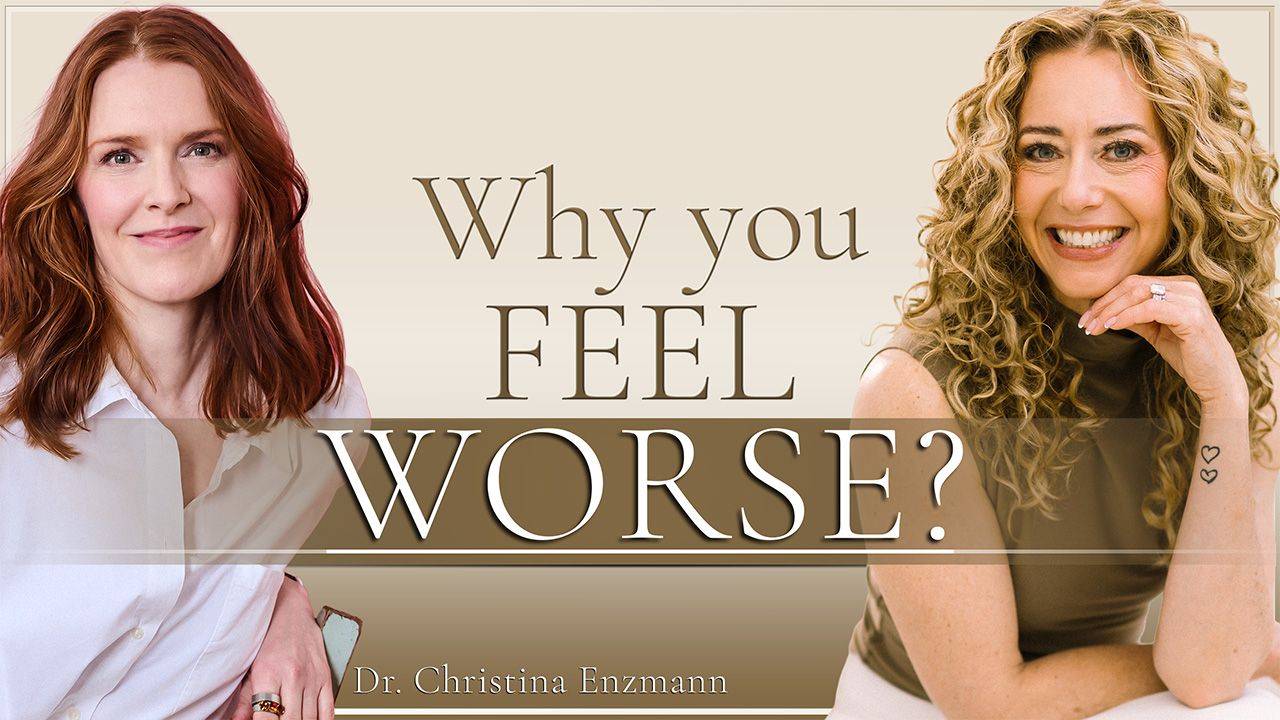
You’re eating less, working out harder, and pushing through exhaustion, but your hair is thinning, your sleep is suffering, and your weight keeps changing. And when your blood work comes back “normal,” you’re left wondering what’s wrong.
In this episode, I sit down with Dr. Christina Enzmann, a board-certified gynecologist, menopause specialist, and functional medicine practitioner, to explore what women need to understand about midlife health.
We discuss why your gynecologist may not specialize in menopause, how chronic under-fueling and excessive exercise can affect your well-being, and why hormone therapy may be only one part of the bigger picture. We also challenge the pressure to stay thin instead of embracing a more sustainable approach to strength, nourishment, and metabolic health.
Your body doesn’t need more punishment. It needs the support to thrive. Discover what it means to move from the corset to the crown.

Conclusion:
Your midlife health journey isn’t about doing more, eating less, or pushing your body harder. Stop fighting your body and start listening to it so you can make more informed choices, advocate for your health, and redefine what it means to thrive in midlife.
In This Episode:
00:00 Why you feel exhausted despite “normal” blood work
07:06 Gynecologist vs. menopause specialist
15:56 How midlife can change your relationship with people-pleasing
22:37 The hidden problem of under-fueling in driven women
28:41 Why hormone therapy isn't the whole picture
32:26 How to recognize and understand the under-fueled woman
40:44 Working with Dr. Christina Enzmann
Order Carrie's Bestselling Book, From Corset to Crown!
Get your copy: https://www.carrielupoli.com/corsettocrown
Join the BS Club:
https://www.disruptivenutrition.com/bsclub
Listen to This Episode on Your Favorite Podcast Channel:
Follow and listen on Apple
Follow and listen on Spotify
Subscribe and watch on YouTube
Connect with Dr. Christina Enzmann:
Connect with Carrie Lupoli:
Other Related Episodes:
Looking for more tips to optimize your health? Listen to these episodes:
- You Don’t Have to Find Your Purpose. You’re Already Living It
- When Wellness Becomes Another Source of Pressure
Transcript:
[00:00:00] Dr. Christina Enzmann: Most gynecologists are not trained in hormones or are, are very uncomfortable because remember, we also were trained in the time after the Women's Health Initiative study, and for some reason, even we have continued to prescribe hormones, just so you know, since 20 years. But this was just a subset of interested gynecologists.
[00:00:19] The rest are just
[00:00:19] Carrie Lupoli: scared. Well, hey there, crown straighteners. Whatever is tightening your corset today, welcome. You're in the right place. I'm just so excited about this episode. If you have ever walked out of your doctor's office and told your blood work was totally fine while you're exhausted, your hair is thinning, you're gaining weight, you're wide awake at 3:00 AM with a hot flash, this episode's gonna be for you.
[00:00:39] So Dr. Christina Enzmann is a medical doctor. She has a PhD. She is a certified menopause specialist and a functional medical practitioner, and she is a breath of fresh air. This is a medical doctor saying out loud what I have been saying for forever about what we need to be doing to be actually able to [00:01:00] be truly healthy.
[00:01:01] We actually talk about what an OBGYN is, what their expertise is in, what it's not in, how yours may not actually be trained for this season of your life. We talk about why so many driven women, like the ones that are up at 4:00 AM working out before kid drop-off, they're actually causing themselves to struggle more than someone who's not doing that.
[00:01:22] We're gonna talk about your thyroid. We're gonna talk about under-fueling. We even talk about a stack of pancakes. We cover the gamut here. She is the author of a book called The Under Fueled Woman, which I just love the title of. You are going to love this episode. I can't wait for you to tune in. Let's go.
[00:01:46] So Dr. Christina Enzmann, welcome to the podcast From Corset to Crown, where you have so much to share as a board-certified gynecologist, as a menopause specialist, as [00:02:00] a functional medical practitioner. This is going to be such an amazing episode for you to just share all the things that you know and you've experienced with all the women that you've worked with, so welcome.
[00:02:10] Dr. Christina Enzmann: Fantastic. Thanks for having me. I'm so excited about this conversation, so let's just go, let's go.
[00:02:16] Carrie Lupoli: Let's do this. You know, you and I were able to meet and have some conversations before we even decided to do this podcast, and some of the things that you were saying to me as a medical practitioner, as a medical doctor, a- and let's, l- let's just be like you're a medical doctor and a PhD, like you're super, super smart.
[00:02:36] But I have seen so many super, super smart people get sucked into kind of the world of our healthcare system, our pharmaceutical system, and really aren't getting us, as women, to where we need to be. And so you were such a breath of fresh air as a medical practitioner who had so many of the same beliefs that I have.
[00:02:59] Dr. Christina Enzmann: Yes, that [00:03:00] is correct.
[00:03:00] Carrie Lupoli: So tell us a little bit about your background. How did you get there? Because you're a unicorn in so many ways. So how did this happen?
[00:03:10] Dr. Christina Enzmann: Well, you know, good question. I'm not entirely sure, but as you can hear, I'm from, I'm from Germany. I grew up there. Actually scho- went to medical school in Germany, and then ended up in the US by accident, like, 23 years ago.
[00:03:22] Carrie Lupoli: By accident. You just stumbled into the US.
[00:03:24] Dr. Christina Enzmann: Like, like, yeah, accident. Yeah. My, my ex-husband, he got a job, and I was actually very happy in Germany. I figured I'm gonna be a u- university professor, and then it just ended up differently.
[00:03:34] Carrie Lupoli: So- And life has a different way of showing up for us, doesn't it?
[00:03:36] Dr. Christina Enzmann: Right.
[00:03:37] And like many expats, we are like, we thought after two years we're gonna go back, and this just never happened. So-
[00:03:42] Carrie Lupoli: Yep. Yep ...
[00:03:42] Dr. Christina Enzmann: that's, yeah, it... There was an accident indeed.
[00:03:44] Carrie Lupoli: I was an expat for a while, almost eight years, and then I, I fought my way back.
[00:03:50] Dr. Christina Enzmann: You know, it takes hard work. I c-
[00:03:51] Carrie Lupoli: Yep ...
[00:03:52] Dr. Christina Enzmann: I couldn't. Anyhow, so that meant for me, I had to redo...
[00:03:57] I had first to do my American state exams while I [00:04:00] was breastfeeding my youngest child, because when we realized on our way back. So I did all of that, and then, you know, I had to go do residency in the US. So I'm not sure if I had a different p- perspective all the time. I always felt I was looking a little bit from outside.
[00:04:15] And I'm not saying that in Germany everything is better. Not at all. It's just a different, you know, variation of- But,
[00:04:21] Carrie Lupoli: well, there is a different, a different approach. There just is. Like, the way that Europe functions with regards to even standards within our food, our pharmaceutical systems. Like, having lived in Europe, having lived in Asia, there is a very different way of looking at healthcare in other countries.
[00:04:40] So I, I would say that, like, it makes a lot of sense for you to walk into it with a different perspective.
[00:04:45] Dr. Christina Enzmann: Yeah, so some o- in between the lines. Some of this clearly I always was looking at other options, or I just had the bigger picture in mind. Back in Germany, I actually also trained back then in, like, traditional Chinese medicine.
[00:04:57] I did this- Yeah ... while I was at med school. So, you know, there [00:05:00] were all kind of things, you know, there was trickling into my, my mind. So it became very natural once I was done with, you know, retraining gynecology and I went out in practice. I just... I don't know what it was, but these midlife women, I immediately felt I want to take that really on.
[00:05:16] However, we were not well-trained in residency, so this is when I immediately b- got the certification for the menopause practitioner within, th- back then, the North American Menopause Society. Now just Menopause Society because they're really, they're like, you know, here for the entire world, which I really love.
[00:05:32] So that's how that really started. And so many women came to me, and then, you know, great data, North American Menopause Soc- Soc- Society, really good supportive of women's midlife. But then, you know, I was the typical midlife conundrum, you know, woman. I had, you know, I had a job at the university. I was super busy.
[00:05:53] I was stressed. I was working nights. I had, you know, two children, and my marriage was falling apart. And you know, and then [00:06:00] midlife crisis for all of us. Like
[00:06:01] Carrie Lupoli: check, check, check, check.
[00:06:02] Dr. Christina Enzmann: All of that. Yep. Yeah. You know, all of that. Yeah. I fell right into all of that. And then I actually started what I call, like, perimenopausing really hard, but I didn't notice.
[00:06:12] I was like- Hmm ... 45, and I'd, as, I would still make fun of myself, because I should've known. I was like, "No, this is the stress," and here and there. And I always like to tell this story. I was used to be, like, cold rather, and suddenly I was warm. And then I felt first this was very nice, and then I had bought myself a whole, the young attending, all these great boots, you know, like these knee-high boots, because found a company that made them for really thin legs.
[00:06:38] So had a whole collection. And I realized I couldn't wear them at work. My feet were burning off. And so
[00:06:44] Carrie Lupoli: Wow.
[00:06:45] Dr. Christina Enzmann: So this was my first sign of, of, you know-
[00:06:48] Carrie Lupoli: Hot feet ...
[00:06:49] Dr. Christina Enzmann: hot feet. So anyhow, so, and later on, you know, I realized. Like, it didn't take long. From 45, you know, the first time I didn't have my menses for three month, for six month, and then [00:07:00] at 48 it was over.
[00:07:01] So it actually-
[00:07:02] Carrie Lupoli: Yeah, I was 46 when I went through menopause. So how do you look at, like, when so many women will go to their doctors, they'll talk about menopause or... And they're just, they're suffering, right? Mm-hmm. And they don't feel like they're getting a lot from their doctor. Help us understand the difference in training for a typical gynecologist versus somebody that's really an expert in hormones and menopause.
[00:07:31] Because I think people automatically assume my gynecologist is also an expert in- hormones and menopause in this stage of life. Can you explain if that's true- Yeah ... or if it's not necessarily automatic?
[00:07:50] Dr. Christina Enzmann: It's not automatic at all. And I love my colleagues, but gynecology is a big specialty. It's from labor, you're delivering babies, to endocrinology, to [00:08:00] urogynecology.
[00:08:00] You can become an oncology specialist, and, you know, office gynecology. So no, not at all. Actually, most gynecologists are not trained in hormones, or are, are very uncomfortable. Because remember, we also were trained in the time after the Women's Health Initiative, Initiative Study. And for some reason, even we have continued to prescribe hormones, just so you know, since 20 years.
[00:08:23] But this was just a subset of interested gynecologists. The rest are just scared. So, and remember, if you deliver babies, you are busy, like 90%, you know. You- this is a whole different world, you know, the more complex symptoms of midlife women. And it's also not like you can just prescribe them hormones, and we're gonna discuss this.
[00:08:43] It's, it's a little piece of a puzzle that is helpful, but it doesn't really change what's underlying. And underlying is so complex. This is not a 10-minute conversation you can have in your office while, you know, the waiting room is full. So I think that is [00:09:00] problem. So you want someone who has time, who understands the conver- these conversations, because it involves the stress axis.
[00:09:08] What does the woman eat? How is she fueling? Is she running on fumes since decades? How is her relationship? Is she working night shift? So all of that. So and you, you understand, y- regular physician that is
[00:09:21] Carrie Lupoli: not- This is why we're so synergistic, because there's very few doctors that I'm talking to that it's not like they'd argue that they're, that that's not important, but they just don't have the time, the training, and the capacity- Yeah
[00:09:35] to dig into it. And you said something really powerful. And, and I hadn't really thought about it like this, and I'm, and I think this is really a, a, a big takeaway for everyone listening. Our doctors, our gynecologists, are really busy delivering babies. And I actually, like, my neighbor just had a baby last month, and she was coming in towards, like, the last few days of it.
[00:09:57] But she was, like, on a wait list a mile [00:10:00] long before they were gonna induce labor because it was just, there was no room. And every day she'd call, and they're like, "Nope, we got no room for you today. Nope, we got no room for you today." And so when you think about that, i- i- and you realize how much time, research, energy it takes to really understand this phase of life, then how is it that w- like, a person can really have that expertise in both areas when they're so busy?
[00:10:24] So you're just making me think about- Do you think when women are at their OB, what are some of the questions that they can ask their doctor to ascertain, are you an expert in this area? Like, this stage of life that I'm in, where are you in your own true confidence in being able to support me? And are those questions that we can ask a doctor?
[00:10:45] Dr. Christina Enzmann: Yeah, of course you can ask, "Hey, are you actually comfortable with, for example, prescribing hormones if necessary? What do you think about midlife care, or is that, what is the focus of your practice?" I'm not delivering babies anymore because I just [00:11:00] realized you can't do it all. And of course, I realized this is not good for my stress axis, just being up all night.
[00:11:07] So-
[00:11:07] Carrie Lupoli: Yeah, seriously ...
[00:11:08] Dr. Christina Enzmann: I
[00:11:09] Carrie Lupoli: would say, yeah, there are young- I have a friend who's a doula, and I'm like, "I do not know how you do it."
[00:11:11] Dr. Christina Enzmann: I'm always saying, hey, there are young colleagues who can do that. So- Yeah ... anyway, the question was, yeah, just be friendly. It's not, if she is mostly, or she or he mostly, you know, their practice is built on maybe still delivering a lot of baby, which is very necessary, then you have your answer.
[00:11:27] And I have some, many patients who are like, "Look, I like my gynecologist, but she's mainly doing, you know, obstetricians, obstetrics, and I just wanted to look for someone who's more specialized in midlife women's care." I think this is a perfect, normal question to ask. There is no offense taken in, in n- for no one.
[00:11:45] Carrie Lupoli: Yeah. No, I think that's great. Okay. So is there also a world in where you would have your gynecologist and your mid- you know, your midlife menopausal hormonal specialist, or really could you move everything over to somebody in terms of, you know, your [00:12:00] gynecological exams, Pap smears, all of that? Ev- Yeah
[00:12:02] like, that's something that you would do for all women, right? You don't have- Yeah ... to separate that out.
[00:12:06] Dr. Christina Enzmann: Yeah, no. I, I just don't do obstetrics anymore, for example. Exactly. So I do everything else, from well-woman exam to Pap smear, but- Yeah ... we focus heavily on midlife women. Right. And sometimes they bring their daughters.
[00:12:17] They're not in midlife yet, but that's also good.
[00:12:20] Carrie Lupoli: Yeah, no, I love that. Because it's like we, we use OB, right? We say that all the time. Yeah. Like it's one thing- Yeah ... but it's really two separate- Yeah ... practices in a lot of ways. Okay. So I love this. We've established this foundation. We know that our gynecologist, our OBGYN, may not necessarily be an expert in our phase of life and what we're doing right now, and you're talking about the fact of the matter is that hormone replacement therapy, or just looking at hormones in an, in a, in a silo, is not what is going to yield the results that we need.
[00:12:54] So this is why I love you so much, and I think that what we talk about is so powerful, [00:13:00] is that- When we actually operate, I, I say from the crown in this stage of life, recognizing that the corset that we have to look a certain way, be a certain way. Like, even the word anti-aging kinda drives me crazy. I feel like it's a little bit corset-driven language because it's like, it's...
[00:13:18] There's something wrong with aging. And at the end of the day, I think it is such a blessing and such a, a power to have wisdom, and I, I don't wanna go back to my 20s. I wanna stay where I am. I just wanna be the healthiest version of where I am here. So I, I want us to be thinking about aging in a way that's aging from the crown, and of self-worth, a- a- and self-love.
[00:13:40] And so how do you work with women to be able to figure out all those pieces of the puzzle?
[00:13:44] Dr. Christina Enzmann: Yeah, so first of all, I wanna tell you there are actually real studies that showed that women when they were asked in their, in the post-menopausal, they said 70% of them were happier than they were in their 30s and 40s.
[00:13:57] So just- Oh,
[00:13:58] Carrie Lupoli: I would definitely say that's true for
[00:13:59] Dr. Christina Enzmann: me ... Yes, [00:14:00] me too, right? So, so that is important. So and I like that you say, like, that's about anti-aging. I also think that it's just silly because what? I don't wanna be 25. No one wants that. We want to live our best, you know, midlife, and it's... Some people even di- don't like the word midlife.
[00:14:17] I'm like, this is a... I don't, I think that it's a good term.
[00:14:20] Carrie Lupoli: It's also a fact.
[00:14:21] Dr. Christina Enzmann: It's a fact, right? It's a fact that- It's just
[00:14:23] Carrie Lupoli: middle of our life.
[00:14:24] Dr. Christina Enzmann: I- it's fantastic.
[00:14:25] Carrie Lupoli: Especially 'cause I'm planning on being 120. I'm not even there yet. I'm not even in the middle yet.
[00:14:30] Dr. Christina Enzmann: Plenty of time, exactly.
[00:14:31] Carrie Lupoli: Yeah. So if you don't know already, From Corset to Crown is already a best-selling book, and it's not even out in stores yet.
[00:14:41] But I want you to have your hands on this because this is going to be a toolbox for you, a reference book, and a daily source of inspiration. It's going to teach you not only the last nutritional advice you will ever need, but it's going to teach you how in every single day life you can go from the corset to the [00:15:00] crown.
[00:15:00] So if you pre-order today, you get all sorts of great things, including the e-book for free before we actually send you the actual book in October. You're also gonna get a 10-episode private podcast that I recorded only for people who pre-ordered the book, where you are going to be able to get a behind-the-scenes story and perspective of all the things that went into getting to the point where I was ready to write the book.
[00:15:28] This is a book I needed 15 years ago, and it's one that I continuously reference. And so not only will you get the private podcast, but I got a secret little gift for you within that, as well as a discussion guide and a private community with me and other people reading the book. So go pre-order the book now.
[00:15:46] Share it with a friend as well. Start a book club, and get yourself moving from corset to crown.
[00:15:56] Dr. Christina Enzmann: So I think it's important to understand this is a great time for us [00:16:00] women, because I always like to say, look, these reproductive hormones, estrogen and progesterone, they're really taking us on a ride for, like, 30 years of our lives, right?
[00:16:08] So we are trying to please our children and our families, and we are trying to accommodate. And, you know, the estrogen and progesterone, I always say these are like the fire extinguishers. They help us so the joints don't hurt, and they make our brain work so we don't forget to pick the kids up from the school.
[00:16:26] However -
[00:16:26] Carrie Lupoli: Although I used to forget sometimes to do that ...
[00:16:30] Dr. Christina Enzmann: right, so
[00:16:30] Carrie Lupoli: We have one time in particular where I absolutely forgot to pick up my daughter. Yes. And I wrote about it in my book because it's that much of a, a memory of, for my daughter. Oh. But anyway, I digress.
[00:16:40] Dr. Christina Enzmann: Don't forget about that. Exactly. Exactly.
[00:16:42] However, you know, I'm saying nature is saying in midlife, "Look, lady, you don't need this anymore. Let the younger ladies deal with that. We are taking this now away, this little brainwash you got for 30 years that made you, you know, help, and, you know, try to please and be pretty and-
[00:16:57] Carrie Lupoli: Sacrifice for everybody else
[00:16:59] Dr. Christina Enzmann: and fit in [00:17:00] your skinniest jeans." Yeah, we're gonna engulf- Yep,
[00:17:02] Carrie Lupoli: wear- wearing the corset. We're all wearing
[00:17:04] Dr. Christina Enzmann: the corset- Exactly ... of that belief. It says, "Go away with this." Now that's why we become relative sensitive for nonsense, I wanna say, as we, you know, transition midlife, and then we are finally... There are other words for that, but I'm trying to say, you're like, "No, this is not working for me anymore."
[00:17:19] So we're really living our best part there.
[00:17:21] Carrie Lupoli: However- I love it. I actually say the corset has put on us... Like, let me look, read what I wrote in the back of my book 'cause I forget sometimes. Diet culture laces you into a corset and then blames you for not breathing. I feel like it's just in general, like, just, like, the cultural conditioning as women that we've had, and then you get to midlife and you're like, "I gotta take this darn thing off anymore.
[00:17:40] I can't breathe."
[00:17:41] Dr. Christina Enzmann: Yeah, that's exactly how it is, and that's the right topic because most women, you know, apart from they come complaining about hot flashes, which has a lot to do with insulin sens- sensitivity and blood sugar roller coasters, but the next thing they complain about, maybe even before the hot flashes, is the weight gain.
[00:17:57] Like, they complain about their belly [00:18:00] bulge and even, you know, if they are, they, they're getting upset even sometimes I think they look great. And I'm asking them, "Well, what does your partner say about that you just got a little bit more on your derrière?" And they're like, "He loves it." And I'm like, "Well, w- " I'm like, "Why is that?"
[00:18:16] Carrie Lupoli: I love, I love that you're bringing this up because this is where- Comparison, I always say comparison is the thief of all joy. Like, we compare ourselves to our younger selves, we compare ourselves to others because our worth and our value has been sucked up in what we look like. And if we look different, then our value is lessened.
[00:18:37] And it drives me crazy to think that this body of ours has done so much for so long. It, it formed and made humans, for goodness sakes, for so many of us, and yet we're so hard on it when it has something extra in there. And, and, you know, I, I, I get that there's a, a piece of us that we don't recognize, but it's also [00:19:00] like where is it coming from?
[00:19:01] And I believe it comes from this lack of self-worth.
[00:19:03] Dr. Christina Enzmann: Yeah, and we are upset that we don't fit in the pants when we were 25 years old. And I wrote in my book, I said, "Look, when I looked at the picture when I was my thinnest," and this wasn't even... That was not when I was 20. It was in my, you know, late 30s when, when we try to be supermom, right?
[00:19:18] We have the job, and we have the kids, and the dogs, and we, we are proud that we can do it all. And I looked at a picture of mine by accident, right? You scroll through your phone, and it shows you, like, a picture from 15 years ago, and I'm like, "Wow, I was thin, but I look like I'm lacking juice. I'm... Who is that thing in the landscape?"
[00:19:37] So I like to say when we are our thinnest, we are really not our best, nor our healthiest. We just think that, and I feel so much better, you know, now than I was back then when probably my joints were also creaking, all of that, which I don't have anymore. So I think We have to... This is what I like what you're saying.
[00:19:56] Like, we have to get rid of that corset and [00:20:00] embrace that body that changes. And I'm not saying we should, you know, become obese. Not at all. Right. But there are gonna be changes even if we talk about in a little bit about how to stay metabolically healthy, how to fuel properly. As we are getting stronger and building muscle and not focused so much on thinness, but really being stronger- Yes
[00:20:21] you know, our body is gonna look different and it's gonna fit different in clothes. I always like to say, look, I, for like in my 30s I was proud that I would fit in like number small, size small blazers. I'm 5'10, I really have broad shoulders, so I was really like, you know, just not eating. I don't know what I was doing.
[00:20:39] And now that I was just doing more exercise, I just popped out of these blazers. And I was so upset, and it took me a couple of month to say, "Christina, you're never gonna fit in these again, and you don't want to," until I said, "I'm gonna give them away." But even me, you know, it took me, like, I had to gnaw on that for a while until I was like- Yeah.
[00:20:58] That's a
[00:20:58] Carrie Lupoli: really good point ... "[00:21:00]
[00:21:00] Dr. Christina Enzmann: Go
[00:21:00] Carrie Lupoli: away with this." Yeah. Right? You really have to dig in and be like, "Okay, wait. Why am I so upset about this? Like, where is it coming from?" Yeah. "Who told me this?" And I, I love that as we get older, we, we hopefully are getting wiser, but the thing that I talk about is becoming the healthiest version of ourselves means you're about to embark on a journey of self-discovery.
[00:21:21] Because your body will react and respond to the various inputs, but also to getting older. And we have to really figure out who we are, because I think all of this work, the work that you do, the work that I do, all in general is actually identity work at the end of the day. You know?
[00:21:38] Dr. Christina Enzmann: Yeah. It's identity.
[00:21:40] And then, you know, I have so many women that arrive in midlife, and they're just not eating enough anymore, and they don't even realize. They have- Yes ... and it's, and it's such a, you know, you m- in the, in the past, I might have thought this is just a few women, and I feel it's, like, about a third to a half of the patients who see me.
[00:21:59] Okay, [00:22:00] I'm also self s- I mean, my patients are kind of self-selecting, right? They come with complex, don't feel well.
[00:22:05] Carrie Lupoli: Yeah, yeah, yeah.
[00:22:05] Dr. Christina Enzmann: These are the ones that are really upset. They are the driven women, I call them, because, you know, these are the one who have everything worked out in their life. So, and if even if the child has, like, m- in the morning at 7:00, they have volleyball class, they are gonna get up at 4:00 to go to the gym.
[00:22:20] So these are the ones, you know, who are used to restricting their diet a little bit more, following the next diet, and then they work out a little bit more, and they kept, you know, their, their s- you know, their weight through their th- 20s to 40s, I wanna say. And then- I
[00:22:37] Carrie Lupoli: hear this a lot. Like, I really didn't have a weight problem until I was hitting menopause.
[00:22:43] And so we blame menopause, but in all reality, to your point, what we've been doing for decades in this restriction and deprivation is actually causing some of the reactions. Would you agree?
[00:22:56] Dr. Christina Enzmann: Yeah. So it's basically we arriving in midlife, you know, at, [00:23:00] uh, like many of us, in this catabolic state, I like to say.
[00:23:03] And we have already, you know, downgraded our metabolism because we have, you know, food restricted us for so long, very unconsciously. Just, you know, let me eat this. Oh, no, I eat enough, Dr. Enzmann. I have a little, you know, my yogurt in the morning with some berries and a little this. Oh, yeah, all this exercise.
[00:23:20] Oh, yeah.
[00:23:20] Carrie Lupoli: Yeah, because we've been told eat less- Yeah ... move more, right? Count your calories, restrict. Like, food is good or bad. You shouldn't really enjoy it. If you wanna be small, you have to actually just literally live in a state of deprivation.
[00:23:34] Dr. Christina Enzmann: Yeah, and then they exercise really hard. But these are- Yeah
[00:23:36] the women who come, you know, they really come to my practice, they are exhausted. Their hair's falling out. Yep. Maybe the next thing they do is, like, a GLP-1, so they're already in... Remember, they're already under-fueled. They're lacking nutrients, and now we are giving them something that's really making that even worse.
[00:23:52] So they are super fatigued, and now I have to explain to them, look, you are, like, in an energy availability deficit. Your body has [00:24:00] long decreased the basic metabolic rate. And if you take one of these, you know, online calculators like, you know, whatever, you cut 200 calories, and then in four weeks you're gonna lose, like, three pounds.
[00:24:10] That's not gonna work for you because your, your rock bottom has already decreased- Mm-hmm ... and your body is already, you know, barely functioning. So this is why we know then, like, the non, non-exercise movement is gonna slow down. We are gonna feel less likely to fidget. You know, we're not gonna take the stairs, but rather the elevator.
[00:24:30] And this has been actually shown in female athletes, so we know that actual exercise avail- um, energy availability. But it applies to midlife women because we have been doing this persistent fasting. So these women I, I have to tell, "You have to eat more, and maybe can't do even..." I know I hear strength training all over the place.
[00:24:48] I'm like, that's fantastic, but not five times a week. Data says two to three-
[00:24:51] Carrie Lupoli: And not when you're under-fueled, especially
[00:24:53] Dr. Christina Enzmann: And not when you're under... And not at 4:00 AM in the morning when you're now disrupting your circadian rhythm. So this is a whole [00:25:00] new thinking that I have to deploy for many of my patients, and it's really hard.
[00:25:04] And they're coming, many, you know, they don't even need an, an eating disorder underlying. It's just we are all- having some disordered thinking about food. I even discovered that in myself, and I was so surprised.
[00:25:17] Carrie Lupoli: Mm-hmm.
[00:25:17] Dr. Christina Enzmann: So this is like your core set. So, and it's really, it's, it's tremendous. It's so many women that I really have to, you know, calculate that and tell them, "Look, you actually have to eat more.
[00:25:28] You have to cut down a little bit of exercise until your body is, is catching up and you're actually fueled properly." And the interesting thing is the moment they start just going, we often have to catch up several hundred calories, but even if they increase it a little more, really very soon they sleep better.
[00:25:45] Mm-hmm. So no one has ever, you know, connected that. So sleep, gut issues, and, you know, we see many gut issues in midlife for many reasons, often hormonally related. However, under-fueling is also gonna give you gut issues through the, the [00:26:00] gut-brain and the gut-stress axis. So, you know, they come, "I can't sleep.
[00:26:03] I'm so, I'm so nervous." I'm like, "Well, you probably..." Many of them need to eat more. There can be many other things going on, but-
[00:26:10] Carrie Lupoli: So do you think that's the very first thing? So when you see a cl- a patient, like, and you're kind of going through all of these things that have to be taken care of, right? And you were just talking about sleep and all that.
[00:26:21] Do you think the underlying first step for most women is food?
[00:26:24] Dr. Christina Enzmann: For many. So I always say there are three types of... They come like butterflies in my office, I say. And butterflies-
[00:26:29] Carrie Lupoli: Oh, I love that.
[00:26:30] Dr. Christina Enzmann: Butterflies have different colors, and I sort them in my head. There are three main colors. One is the pre-diabetic one, or the insulin resistant, right?
[00:26:38] They, they really, in my head that is easy. They just, we have to talk about, you know, nutrition, you know, cutting sugars. Easy in my mind. The second part is this under-fueling category, so, and they either might not be even exercising that much, but let's say many have one meal a day. So I know they're under-fueling.
[00:26:54] Or the ones, what they tell me they're eating actually sounds okay until they tell me how much they [00:27:00] exercise. Then I do know they're also under. So these are the under-fueling. And then the third category in my head is the ones who have lost muscle. You know, they just had, you know, who I know, okay, you're getting metabolically unhealthier because you've lost muscle.
[00:27:14] So they, you know, and then of course I always say butterflies have all the colors from, you know, all kind of dots and sprinkles, so it kind of mixes. But I have them roughly, you know, like that in my head. So I would say it's a easy a third of them that, you know, again, me, menopause specialty practice for more com- people who feel like no one understands what's going on with them, so they're kind of self-selected.
[00:27:35] But I have, like, a third to a half that fall into that category, and that is really wild. But you only find out if you actually ri- ask the right questions, and the questions are not difficult. It's just What are you eating and, like, how much do you exercise?
[00:27:50] Carrie Lupoli: Those are your first initial questions, right?
[00:27:52] Dr. Christina Enzmann: Pretty much, yes.
[00:27:53] Carrie Lupoli: Yeah. Mm-hmm. Yeah. And so when we think about menopause, we often think th- so, [00:28:00] uh, like I focus on a lot of the things that you are talking about here, right? We're talking about fueling our bodies, movement, we call 'em the six spinning plates, uh, nutrition, exercise, sleep, managing your stress, supplementation, and hydration.
[00:28:12] But in your practice, in, well, in your world, you must get a lot of questions about hormone replacement therapy, and so I know that there's... We both believe that there's a place for that. I mean, I'm on HRT, and I know that that's a, a piece of the puzzle for me that was important because at the end of the day, like, if, if, if women decide to go on HRT, like, these...
[00:28:32] We can't create more estrogen just because we're fueling ourselves, although we can create so much more homeostasis and balance. So when is HRT something that you want to introduce into the conversation? Is it before you start talking about the food and exercise? Is it after? Is it conjunction? Like, what's your thought process on that?
[00:28:55] Dr. Christina Enzmann: All together. These women need help right away. So for me, you know, HRT is, [00:29:00] is a great Band-Aid solution. So it's perfectly valid. It's safe. But I want them to understand, yes, you, you know, you have no contraindications. Yes, I can prescribe that, no problem at all, but let's look at your average blood sugar.
[00:29:12] Let's look at your hemoglobin A1C. Let's talk about your food. Because otherwise, you're gonna be, after three months, you're gonna be coming back, and you're gonna be like, "Dr. Enzmann, I need more of the hormones. It stopped working." And I'm like, "No, no, no, it's not funny, it stopped working suddenly." It's like we haven't addressed the underlying issues.
[00:29:28] So-
[00:29:28] Carrie Lupoli: And your body's not ripe for being able to accept what the HRT can do if you're not actually focusing on those pieces.
[00:29:36] Dr. Christina Enzmann: Yes, and you know, the other thing I just decline to, to have that thinking that we, like, menopause is kind of like a, a time of decline. That's not what, what nature made for us. It's not like we can't live with these hormones.
[00:29:48] And of course, we produce a little bit ourselves, even in post-menopause. You know, but it's not that nature decided it takes this away and we are gonna, you know, fuzzle away. That's not what it is. There is a [00:30:00] perfect time for us afterwards. So it's not that we need these reproductive age hormone levels.
[00:30:06] That's why we call it menopausal hormone therapy actually now, not meno- hormone replacement therapy.
[00:30:11] Carrie Lupoli: Yes. Actually, that's true. Because- I sh- I, I ha- I get stuck in that language 'cause I've used it for so long.
[00:30:15] Dr. Christina Enzmann: Me, me too. But yeah. Yeah. But right now it's important to point this out because what we mean with that name change is, hey, we are not trying to restore premenopausal hormone levels.
[00:30:24] We are just giving you a little bit to manage your symptoms. And the symptom is hot flashes. For this, it works really well. However, also know if you have blood sugar rollercoasters, that's gonna give you extra hot flashes because the-
[00:30:37] Carrie Lupoli: Exactly. I had one of my clients who was, like, stabilizing her blood sugar, and then she had an appreciation meal where she was just like, "You know, I'm not focusing on anything.
[00:30:45] I just wanna eat whatever I wanna eat," and it was like a big stack of pancakes. Oof. And she couldn't sleep. She woke up with hot flashes the whole night. Yeah. It was so funny. She's like, "I had no eggs. I had nothing but pancakes." And she's like, "And that was in the morning," [00:31:00] and she had hot flashes all night.
[00:31:01] It was just so- Yeah ... so interesting. Yeah. Well- When she had not had hot flashes in a, a year and a half.
[00:31:06] Dr. Christina Enzmann: Well, I can explain that because that insulin that she's gonna be released for all these pancakes stimulates the thermoregulatory center in the hypothalamus where estrogen used to dock. So yes, it's so you get the blood sugar swing that's now gonna mess with your cortisol level.
[00:31:21] That's why she can't sleep. But in the meantime, that insulin docks on the, the, the thermoregulatory center. So similar with alcohol. So I always tell people, "Look, if you wanna have your glass of wine every now and then, that's perfect. Have it. But then you have your hot flashes, too. Don't call me- Uh-huh
[00:31:37] the next day and tell me you had hot flashes again." Yeah. That's how I feel too. I have my wine every now and then, and then I'm, "Oh, good. I'm gonna be hot
[00:31:44] Carrie Lupoli: tonight."
[00:31:44] Dr. Christina Enzmann: Yep.
[00:31:44] Carrie Lupoli: Well, then I do. Exactly.
[00:31:46] Dr. Christina Enzmann: So
[00:31:46] Carrie Lupoli: I have my wine now- Like earlier ... much earlier if I'm gonna have a glass of wine than having it before I go to bed.
[00:31:54] But all right. So let's dig into a little bit of what you call underfueling, and I love that [00:32:00] term. I talk all the time, even in my children's nutritional literacy program and book, we, we... It takes place in a gas station because food is fuel. And so I love that you are talking about underfueling, and in fact, your book that comes out in December is called The Underfueled Woman, and I just think, ugh, I love that title so much.
[00:32:20] I think that's going to resonate with so many people. What do we... W- when you're working with your patients- What do you consider being under-fueled? How do you know if they're under-fueled, and what are your recommendations for fueling appropriately?
[00:32:34] Dr. Christina Enzmann: Yeah. Well, there's actually, again, there's a calculator.
[00:32:37] It comes out of ath- athletic research. It's the energy availability calculator, and it goes different from what you get in a regular app. This now actually looks at what do you eat, how many calories through a week, and then you average that through seven, so we see how much do you take in per day, and then we calculate based on your exercise sessions how much additional calories you actually need.
[00:32:58] So, and then it's [00:33:00] called, this is an energy availability, and you can be positive, like in a positive area where we can say, "Oh, you actually, you could really build muscle now. Your body has enough to rebuild- Right, 'cause you
[00:33:10] Carrie Lupoli: really can't build muscle, uh, if, if you're, if you don't have the energy availability.
[00:33:14] Dr. Christina Enzmann: Ex- exactly. Or, you know, most of my women, they're actually in a suppression zone, so they're in a negative energy availability. Energy availability meaning the fuel that is left over once we have accounted for the exercise and your movement, all of that. And if there's nothing left for the body, it's basically the body is telling us, turning the oven down, the flame, so it goes on a, you know, very minimal.
[00:33:36] It tries to save everything. Its insulin rises. Insulin resistant gets worse. This is when we are basically storing... When you eat, your body is gonna store that immediately, and if you are continue to exercise, it's gonna break down muscle, because it doesn't wanna take on the reserves. It's gonna keep hold onto your fat, break down the muscle.
[00:33:56] And these are the women who are righteous- rightfully saying, [00:34:00] "I'm exercising so hard, but I feel like I'm, I'm, I'm losing muscle and gaining, you know, fat." Sometimes they do a body composition scan. Then it becomes- Yeah, it's getting worse ... really clear, and I'm like, "Yeah, you're not imagining that. That's indeed what's going on.
[00:34:13] Your body is in a famine mode, and it's, like, barely holding on." And then when you look very closely at their labs, you can actually tell the thyroid's stopped converting T4 to T3. T3 is this active thyroid hormone, our metabolism pusher, and basically the thyroid is saying, "Oh, no, no, no, no. Let's keep this metabolism very, very, very, in a very slow flame because we, we, I don't know.
[00:34:35] This lady is not eating." So, um-
[00:34:37] Carrie Lupoli: You bring up a good point, because I always get so frustrated the minute somebody says, "Well, now I have thyroid issues. I've just been diagnosed with thyroid issues," and I'm like... And then I'm just given medication for it, and I'm like Ugh. H- how is it that we're not recognizing the basic science of our body that what's causing that?
[00:34:56] Dr. Christina Enzmann: Yeah.
[00:34:57] Carrie Lupoli: And why are we just prescribing a [00:35:00] Band-Aid versus actually just getting to the root of it all? And I, I just love that you brought that up because I think so many women see themselves as having a thyroid issue or, or have been diagnosed with a thyroid issue, and they're not given any other, you know, response other than a medication.
[00:35:16] Dr. Christina Enzmann: Yeah. And they have hair loss indeed, right? They start having- Yep ... hair loss because the body's under-fueling and has a thyroid condition. Yes, and they, you know, they can't sleep. They are super fatigued. They are the ones who sleep all night or wake up, but even if they sleep, they are still fatigued in the next morning.
[00:35:33] That is that under-fueled body. So, and again, that's when I have to explain it to them. It's such a new concept because your
[00:35:39] Carrie Lupoli: target- It is. It really is. I- But I love, though, The Under-fueled Woman. So how... Tell us about what that book is going to actually show us and teach us.
[00:35:46] Dr. Christina Enzmann: Yeah, so it's a, it's a whole concept, and it comes with a workbook so you can actually assess yourself, see where you're falling into that category.
[00:35:55] And that's- I love that ... you know, some of the- I
[00:35:56] Carrie Lupoli: love a good activity.
[00:35:57] Dr. Christina Enzmann: Yes, exactly. Like- It's the
[00:35:58] Carrie Lupoli: teacher in me.
[00:35:59] Dr. Christina Enzmann: And [00:36:00] just check if you are the under-fueled woman or you are more where I say we have to heal the metabolism, maybe more insulin resistance. So it accommodates for, for all of these. And then I'm giving you an exercise, like letting you within simple app, you know, just see how much you actually eat per week, and then I let you actually see average for the amount of exercise you do, how much would you actually need to eat, and then you can see how much you, how you are in suppression or not.
[00:36:25] And then it goes with can we do in terms of how do you refeed. You cannot just have 500 calories extra from today to tomorrow because your gut is gonna say, "I'm not used to that." So it's a little- Yeah ... it's a slow refeeding. But it's... That sounds very clinical. But it's basically meaning, hey, have 100 to 200 calories extra a day, which can be like a little, some edamame beans or they're all kind of simple things that you can actually do, and then just see how your sleep and your gut improves.
[00:36:53] So this is really what it's about. And then, you know-
[00:36:56] Carrie Lupoli: Do you go into kind of the idea that all calories are not created equal? [00:37:00] Oh- 'Cause we get so stuck in the caloric world of, like, 250 calories of an Oreo cookie being the same as 250 calories of some sort of a protein, fat, and carbohydrate that's whole food.
[00:37:11] Dr. Christina Enzmann: Of, you know, this is for me understood. I'm not even mentioning this. Absolutely. I'm, you know, I'm like saying, of course, please, the sugar, you know, and the processed foods, of course that needs to go.
[00:37:21] Carrie Lupoli: Uh- Yeah ...
[00:37:21] Dr. Christina Enzmann: so.
[00:37:21] Carrie Lupoli: It's so crazy because it's just the fact that we have to even, like, recognize that, but the diet culture has taught us that it's just calories in versus calories out- Yeah
[00:37:30] and all calories count, and it's just like, it, it isn't even what you are what you eat. It's you are what you absorb, and we can't absorb- Yeah ... that, that stuff, you know?
[00:37:38] Dr. Christina Enzmann: Yeah. So. And talking about absorption, so yes, I'm a very plant forward, you know, I always say, hey, make sure you get your fiber, and then, you know, the protein.
[00:37:46] I'm always asked how much protein, and I'm like, look, I have nothing against protein. I just don't want this protein hype right now make out crowd- The greens and the veggies. That's my problem with the protein hype because sometimes women, they can barely eat. [00:38:00] Now you give them, like, 50 grams of protein, then they are full, and now we have done nothing for our gut microbiome Yeah,
[00:38:07] Carrie Lupoli: yeah
[00:38:07] Dr. Christina Enzmann: which needs fiber. And so again, I'm say- you know, of course, if
[00:38:11] Carrie Lupoli: you- Well, because this is what diet culture and the course it does. It's like, okay, no, that's not, quote-unquote, working for you? Okay, eat more protein, eat more protein, eat more protein, and then it's like we don't actually treat it like an ecosystem.
[00:38:22] We just treat it like a whack-a-mole, you know? And that's where it's just so hard for women because they hear this and they hear this, and they just hear more rules versus recognizing the overall approach and mindset to becoming truly healthy.
[00:38:38] Dr. Christina Enzmann: Yes. Eat, eat real food, really. That is the best. Yeah. You know?
[00:38:42] Carrie Lupoli: Eat your food.
[00:38:43] Dr. Christina Enzmann: And then, and oh yeah, I do he- I do protein doctor, and, "Here's my new protein powder." And I'm like, well, this is processed food. I'm not saying you can- Right ... never help yourself out with that a little bit, but this is not eating, you know?
[00:38:53] Carrie Lupoli: Right.
[00:38:54] Dr. Christina Enzmann: So.
[00:38:55] Carrie Lupoli: It's, it's, it's food-like substances. Yes. It's not actually food.
[00:38:59] It's something. It's [00:39:00] made in a factory, not- Yeah ... you know, at a farm and in a kitchen. So I'm really excited about your book coming out, and it will be in December. But I know that you also have, until then, something for our listeners to be able to start working on with your, the, the things that you're talking about here.
[00:39:15] Dr. Christina Enzmann: Yeah, it's called the Midlife Health Reset Guide. It's just a downloadable PDF where I give you... You know, we haven't even talked about how the stress axis really makes all of this wor- worse. So yes, there's, it's a guide about what things to adjust from sleep to how to eat to what things maybe to let go for a little bit.
[00:39:35] Coffee is one of the things that my, most my patients hate me for.
[00:39:38] Carrie Lupoli: I know. We do that too, and I'm like, "Listen, I'll never tell you what you can or can't do, but I'll help encourage you, empower you, and educate you to understand why some of those things may be good to decline for a little while."
[00:39:52] Dr. Christina Enzmann: Yeah, and I've always, I'm saying, look, I understand.
[00:39:54] I like coffee too, but I'm not the one who has the hot flashes.
[00:39:57] Carrie Lupoli: Right, right. [00:40:00] Exactly. What do you want and why do you want it? Yes. And that's really what we're trying to get at here. And, and yeah, I mean, stress is such a big piece of this, and I always talk about the fact that, like, people say, "How do I reduce my stress?"
[00:40:10] But this is really, I think- Stress in so many ways comes from this corset of trying to do it all, be it all, over-perform, sacrifice for everyone else, and consistently put ourselves last. But when we say, "I love myself too much not to show up for myself," and we put on the... and not put on the crown, but recognize that the crown that we were born with should al- always be the focus, it's amazing how alignment can help alleviate stress in so many ways, and start to say no to even the good things.
[00:40:39] And so I love that you take so much time with your clients to get to know them. Can people work with you outside of where you are? Like, r- tell people where you actually are located, your office.
[00:40:50] Dr. Christina Enzmann: Yeah. So actually, I'm in Baltimore, but my, my, my functional medicine practice is indeed online. So when I really take time out of my otherwise busy GI practice Yes
[00:40:59] so [00:41:00] I do functional medicine. That's online, so that you don't have to be in Maryland for that. And my Maryland practice, so in person, that is only two half days a week when I, you know, do straightforward gynecology, some straightforward hormone, hormone, menopausal hormone therapy, things like that. But if you have really complex things you would like me to work with you and understand, you know, how to heal your metabolism, get...
[00:41:23] Let's say it like this, depending where you are, that is online work, and my website is drchristinaensmann.com, and you can send me an email, get in contact with me that way.
[00:41:32] Carrie Lupoli: I love that. I love bringing to our audience like-minded practitioners, especially medical doctors, because I, I think so many of them have a hard time really determining who's in this space that's going to support me with the lifestyle that I'm working to achieve.
[00:41:48] And so Dr. Christina absolutely is one of those people. So we've got your reset guide that we'll be able to download, your book that comes out in December, as well as your practice. [00:42:00] So we'll make sure all of your information is here, and all of that. So I wanna ask you a question that I did not prepare you for, so you can start-
[00:42:07] to think about this. Now
[00:42:08] Dr. Christina Enzmann: I'm scared.
[00:42:08] Carrie Lupoli: But how do you straighten your own crown on a regular basis?
[00:42:14] Dr. Christina Enzmann: Well, I would say that's a good question. I'm like, "I'm good enough." And I have achieved all these things, and, you know, I'm like, "I'm good enough." This is what I tell myself. I think when I'm stressed and we have a thousand things going on and I think, "How am I gonna do this?"
[00:42:30] I'm like, "I'm good enough." That's how I do it.
[00:42:34] Carrie Lupoli: I love that. Yes. I love that. Yeah, I think it's a really important question for us to always ask ourself, "Did I straighten my crown today? How did I straighten it?" Yep. So Dr. Christina Enzmann, thank you so much for being here. This is, like, such a breath of fresh air to be able to see somebody with so many credentials like you have to reinforce the stuff that, like, we know.
[00:42:54] We know. I, I joke that we're conspiracy theorists because we know that, like, [00:43:00] w- what we're being told isn't what we really need, but, like, we're not really always being told w- or supported in what we want, and you are one of those doctors that does. So thank you for doing this, for being on this podcast, and for showing up for women in the way that you do.
[00:43:16] You're amazing. Thank you.
[00:43:17] Dr. Christina Enzmann: Thanks for having me, and h- hello to everyone out there.